

What is fair trade tea and why it matters for buyers
Many tea drinkers assume fair trade certification automatically guarantees higher farmer incomes and ethical production, but the reality is more nuanced. Fair trade tea ensures minimum prices, community premiums, and compliance with social and environmental standards, yet its impact varies widely across regions and producer organizations. Understanding what fair trade tea truly delivers helps you make purchasing decisions aligned with your values while supporting sustainable agriculture. This guide clarifies certification mechanics, examines real-world impacts on farming communities, addresses common criticisms, and provides practical strategies for selecting tea that genuinely supports smallholder livelihoods and environmental stewardship.
Table of Contents
- Key takeaways
- Understanding fair trade tea: certification, standards, and pricing
- The social and economic impact of fair trade tea on farmers and communities
- Critiques and limitations of fair trade tea certification
- How to make informed eco-conscious tea choices as a buyer
- Explore eco-friendly tea and coffee blends at EcoVibe Roast
- What is fair trade tea FAQ
Key Takeaways
| Point | Details |
|---|---|
| Pricing and premiums | Fair trade sets a minimum price and pays community premiums that fund development projects. |
| Audits and standards | Audits by FLOCERT verify compliance with social, economic, and environmental standards to maintain certification. |
| Impact on farmers | Research shows modest income gains for smallholders but improved organization, risk management, and capacity building within producer groups. |
| Consumer guidance | Consumers should verify certifications and consider combining fair trade with organic labels or other models to maximize impact. |
Understanding fair trade tea: certification, standards, and pricing
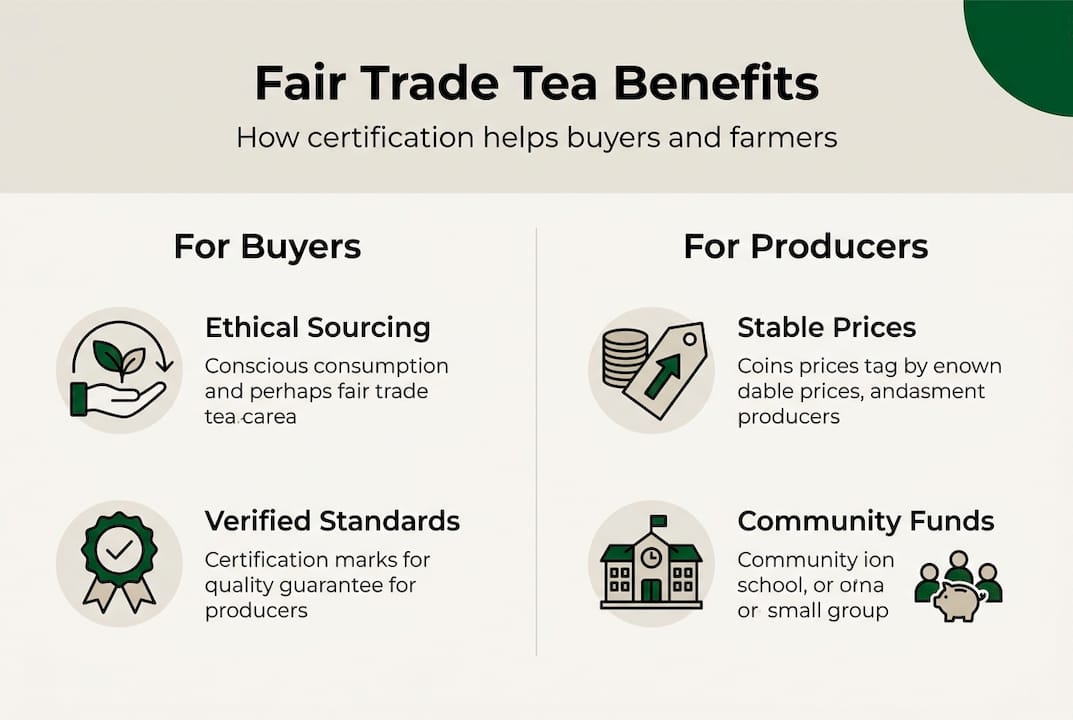
Fair trade tea operates through a structured certification system designed to protect smallholder producers while promoting sustainable practices. Fair trade tea is certified under Fairtrade International standards, ensuring a minimum price floor, additional premiums for community development, and adherence to social, economic, and environmental criteria. This certification primarily targets small producer organizations rather than large plantations, though hired labor standards also exist.
The certification process involves application to FLOCERT, the independent auditing body that verifies compliance with Fairtrade Standards. Audits examine traceability systems, product composition, human rights due diligence, and environmental management practices. Certificates remain valid for four years, with periodic surveillance audits ensuring ongoing compliance. Producers must demonstrate democratic governance structures, safe working conditions, and transparent financial management to maintain certification status.
Pricing mechanisms form the financial backbone of fair trade tea. Fairtrade sets minimum prices ranging from $1.20 to $2.40 per kilogram for conventional CTC black tea depending on region, with Southern Africa and Sri Lanka having distinct price floors. Beyond minimum prices, producers receive premiums of $0.30 to $0.50 per kilogram for social projects, which cooperative members decide democratically. These premiums fund infrastructure improvements, education programs, and agricultural training.
| Region | Conventional CTC black tea minimum price | Organic premium | Social premium |
|---|---|---|---|
| Southern Africa | $1.20/kg | +$0.30/kg | $0.30/kg |
| Sri Lanka | $2.40/kg | +$0.40/kg | $0.50/kg |
| India (Assam) | $1.80/kg | +$0.35/kg | $0.40/kg |
Key criteria producers must meet include:
- Democratic organizational structures with transparent decision making processes
- Prohibition of child labor, forced labor, and discrimination
- Safe working conditions with protective equipment and training
- Environmental protections including water conservation and pesticide reduction
- Financial transparency with regular audits and member access to records
Pro Tip: Prioritize teas carrying both fair trade and organic certifications to maximize environmental and social benefits, as organic standards prohibit synthetic pesticides that harm ecosystems and farmworker health. Combined certifications indicate comprehensive commitment to responsible sourcing practices that protect soil health and biodiversity while ensuring fair compensation. Understanding tea certifications helps you identify products meeting rigorous third-party standards rather than relying on vague marketing claims.
The social and economic impact of fair trade tea on farmers and communities
Empirical research reveals that fair trade certification produces mixed but meaningful outcomes for smallholder tea producers. Studies show modest income and production effects for smallholder tea farmers but significant improvements in organization, input use, wealth accumulation, and risk management attitudes. Comparative research in China and Sri Lanka found that certified cooperatives demonstrated stronger social cohesion and economic resilience than non-certified counterparts, even when direct income gains remained limited.
The premium structure creates tangible community benefits beyond individual farmer payments. Cooperatives democratically allocate social premiums to projects addressing local priorities. Common investments include:
- Educational facilities and scholarship programs for farmers’ children
- Healthcare clinics and medical equipment for rural communities
- Agricultural training on sustainable practices and quality improvement
- Infrastructure improvements like roads, water systems, and storage facilities
- Gender equity programs supporting women’s leadership and economic participation
These collective benefits strengthen community resilience and create opportunities that individual smallholders could not achieve alone. However, challenges persist. Certification costs average $2,000 to $5,000 per cooperative annually, which translates to significant per-farmer expenses for small organizations. Additionally, fair trade sales typically represent only 10 to 30 percent of a cooperative’s total production, limiting the overall impact of premium payments.
“Purchasing Fairtrade tea supports approximately 50,000 farmers with stable income during market volatility, but systemic change requires broader policy interventions beyond certification alone.”
Risk management improvements represent a less visible but crucial benefit. Certified farmers report greater confidence in investing in quality improvements and sustainable practices because minimum prices protect against catastrophic market crashes. This security enables longer-term planning and experimentation with organic methods or specialty tea production. Studies document improved household assets, better nutrition, and increased savings among certified cooperative members compared to control groups.

Pro Tip: Research how specific cooperatives use premiums by reviewing annual reports and impact statements available through transparency initiatives. Look for detailed breakdowns of premium allocation and measurable outcomes rather than vague sustainability claims. This verification ensures your purchases support genuine eco-conscious practices rather than superficial marketing.
Critiques and limitations of fair trade tea certification
Fair trade certification faces substantial criticism from economists, development practitioners, and agricultural researchers who question its effectiveness and unintended consequences. Critics argue Fairtrade distorts markets by creating artificial price floors that encourage overproduction, with benefits often failing to reach the poorest farmers due to certification costs that exclude the most marginalized producers. These critiques deserve serious consideration alongside the system’s documented benefits.
Five major criticisms dominate the debate:
- Market distortion through artificial price floors incentivizes overproduction, potentially depressing global prices and harming non-certified farmers who face increased competition without premium access.
- High certification and compliance costs create barriers for the smallest and poorest producers who need support most, effectively excluding vulnerable farmers from participation.
- Limited poverty reduction impact due to modest income gains that fail to lift households above poverty lines, particularly when fair trade sales represent small portions of total production.
- Corporate greenwashing concerns as large companies use fair trade labels for marketing benefits while maintaining exploitative practices in non-certified supply chains.
- Dependency creation where farmers rely on certification rather than developing market skills and direct buyer relationships that could generate higher long-term returns.
Mass balance certification adds complexity to authenticity concerns. This system allows companies to purchase fair trade credits equivalent to their certified tea volume but physically mix certified and non-certified tea in final products. While mass balance reduces supply chain costs and expands market access, it means consumers cannot guarantee their specific tea leaves came from certified farms. This practice fuels skepticism about whether fair trade delivers genuine traceability and impact.
“The fundamental tension in fair trade lies between providing immediate price stability to current participants versus creating market conditions that enable broader systemic change benefiting all smallholder producers.”
Proponents counter that price stability during market volatility provides crucial security for vulnerable farming families, enabling investments in education, healthcare, and sustainable agriculture that compound over time. Community premiums fund infrastructure and services that governments fail to provide in rural areas. The debate ultimately reflects different theories of development, with fair trade representing incremental improvement within existing market structures rather than revolutionary transformation.
Balanced assessment requires acknowledging both benefits and limitations. Fair trade certification provides meaningful support to participating cooperatives while falling short of comprehensive poverty alleviation. For eco-conscious consumers, understanding these tradeoffs enables more realistic expectations about what fair trade purchases accomplish. The fair trade movement faces ongoing challenges in demonstrating impact at scale while maintaining credibility with skeptical observers.
How to make informed eco-conscious tea choices as a buyer
Navigating tea certifications requires understanding how different models compare and what labels genuinely guarantee. For eco-conscious consumers, Fairtrade tea offers price floors protecting against market crashes and premiums for sustainability projects, but impacts remain modest compared to direct trade models that potentially deliver higher premiums without certification barriers. Evaluating these tradeoffs helps you select products aligned with your priorities.
| Certification model | Price premium to farmers | Impact focus | Main barriers |
|---|---|---|---|
| Fairtrade | Minimum price + $0.30-0.50/kg | Community development, price stability | Certification costs, limited market access |
| Direct trade | Typically 20-40% above market | Direct farmer relationships, quality incentives | Requires buyer commitment, no third-party verification |
| Organic | Varies by market demand | Environmental health, pesticide elimination | Transition costs, yield reductions |
| Rainforest Alliance | Market-based pricing | Biodiversity, farm management | Lower premiums than Fairtrade |
Authentic fair trade verification requires checking for official Fairtrade International or Fair Trade USA marks on packaging. These logos indicate third-party certification rather than self-declared claims. Mass balance products should clearly state this designation, allowing you to decide whether physical segregation matters for your purchasing criteria. Verify certification status through online databases maintained by certifying organizations.
Practical buying strategies for maximizing impact:
- Prioritize products combining multiple certifications like fair trade plus organic for stacked environmental and social benefits
- Research cooperative names listed on packaging and review their public impact reports documenting premium use and community projects
- Support brands demonstrating long-term relationships with specific producer organizations rather than switching suppliers frequently
- Consider direct trade options from roasters and retailers publishing transparent pricing breakdowns and farmer profiles
- Balance fair trade purchases with support for other sustainable models to diversify your impact across different producer communities
Label reading requires attention to specific claims versus vague sustainability language. Look for certification body names, license numbers, and clear statements about what percentage of ingredients carry certification. Generic terms like “ethically sourced” or “socially responsible” lack third-party verification and may indicate minimal actual standards. Compare organic versus fair trade certifications to understand how each addresses different aspects of sustainability.
Pro Tip: Combine fair trade certification with organic standards to address both social equity and environmental protection, as conventional fair trade allows synthetic pesticides that harm ecosystems and farmworker health. Dual certification ensures comprehensive sustainability covering fair wages, safe working conditions, and ecological stewardship. This approach maximizes positive impact across multiple dimensions rather than optimizing for single criteria.
Explore eco-friendly tea and coffee blends at EcoVibe Roast
If you’re ready to put these fair trade principles into practice, EcoVibe Roast offers carefully curated teas and coffees that prioritize sustainable sourcing and environmental impact. Our selection emphasizes organic certification and transparent supply chains, ensuring your purchases support both ecological health and farming communities. Every order contributes to mangrove planting and ocean plastic removal, multiplying your positive impact beyond the cup.

Explore our organic tea collection featuring hibiscus berry tea with vibrant flavor profiles, delicate jasmine tea sourced from sustainable gardens, and warming apple cider rooibos blends perfect for conscious consumers. Each product page details sourcing practices and certifications, giving you transparency to make informed choices aligned with your values.
“At EcoVibe Roast, we believe exceptional flavor and ethical sourcing are inseparable. Our commitment to sustainability extends from farm partnerships through packaging choices, ensuring every sip supports the planet and its people.”
Pro Tip: Subscribe to regular deliveries or bundle multiple products to reduce shipping emissions and packaging waste while enjoying cost savings. Subscriptions ensure you never run out of your favorite sustainable teas while maximizing environmental efficiency through consolidated shipments.
What is fair trade tea FAQ
What does the fair trade label on tea actually guarantee?
The fair trade label guarantees producers received a minimum price floor protecting against market crashes, plus an additional premium of $0.30 to $0.50 per kilogram for community development projects. It also certifies compliance with social standards prohibiting child labor and requiring safe working conditions, along with environmental criteria promoting sustainable agriculture practices.
How can I verify that a tea is truly Fairtrade certified?
Look for official Fairtrade International or Fair Trade USA logos on packaging, which indicate third-party certification rather than self-declared claims. You can verify certification status by searching producer names or license numbers in online databases maintained by Fairtrade International and checking whether products use mass balance or physical segregation systems.
What are the main differences between fair trade and direct trade tea?
Fair trade uses third-party certification with set minimum prices and premiums, focusing on community development through democratic cooperatives. Direct trade involves direct buyer-farmer relationships without certification requirements, often paying higher premiums (20 to 40 percent above market) but lacking standardized verification of social and environmental practices.
Does buying fair trade tea really support small farmers?
Fair trade purchases provide modest income benefits and significant organizational support to approximately 50,000 certified farmers globally, though impacts vary by cooperative and region. Price stability during market volatility and community premiums for infrastructure create meaningful benefits, but certification costs and limited fair trade sales volumes restrict overall impact on poverty reduction.
Can fair trade tea be both organic and fair trade certified?
Yes, tea can carry both fair trade and organic certifications simultaneously, with organic premiums adding $0.30 to $0.40 per kilogram beyond fair trade minimums. Dual certification addresses both social equity through fair pricing and environmental protection through pesticide elimination, offering comprehensive sustainability benefits that single certifications cannot achieve alone.