

TL;DR:
- Carbon-neutral coffee initiatives encompass insetting, biochar-based removal, agroforestry, footprint measurement, and certification schemes to address climate impacts across the entire supply chain. Authentic programs link measurable field-level reductions directly to farmers’ income and verify results through independent standards, avoiding greenwashing. Consumers should ask brands for specific project details and certification verification to ensure genuine environmental and social impact.
Carbon-neutral coffee initiatives are programs that measure, reduce, and balance the greenhouse gas emissions produced across the entire coffee supply chain, from farm to cup. The industry has moved well beyond simple offset purchases. Today, the leading types of carbon-neutral coffee initiatives include supply-chain insetting, biochar-based carbon removal, regenerative agroforestry, full-footprint measurement with verified offsets, and science-based certification schemes. Brands like Cooxupé, Puro.earth, Löfbergs, Pretty Bean Coffee Co, and Lavazza are each pioneering a distinct approach, and understanding the differences helps you make genuinely informed choices about the coffee you buy.
1. The insetting model: carbon reduction within the supply chain
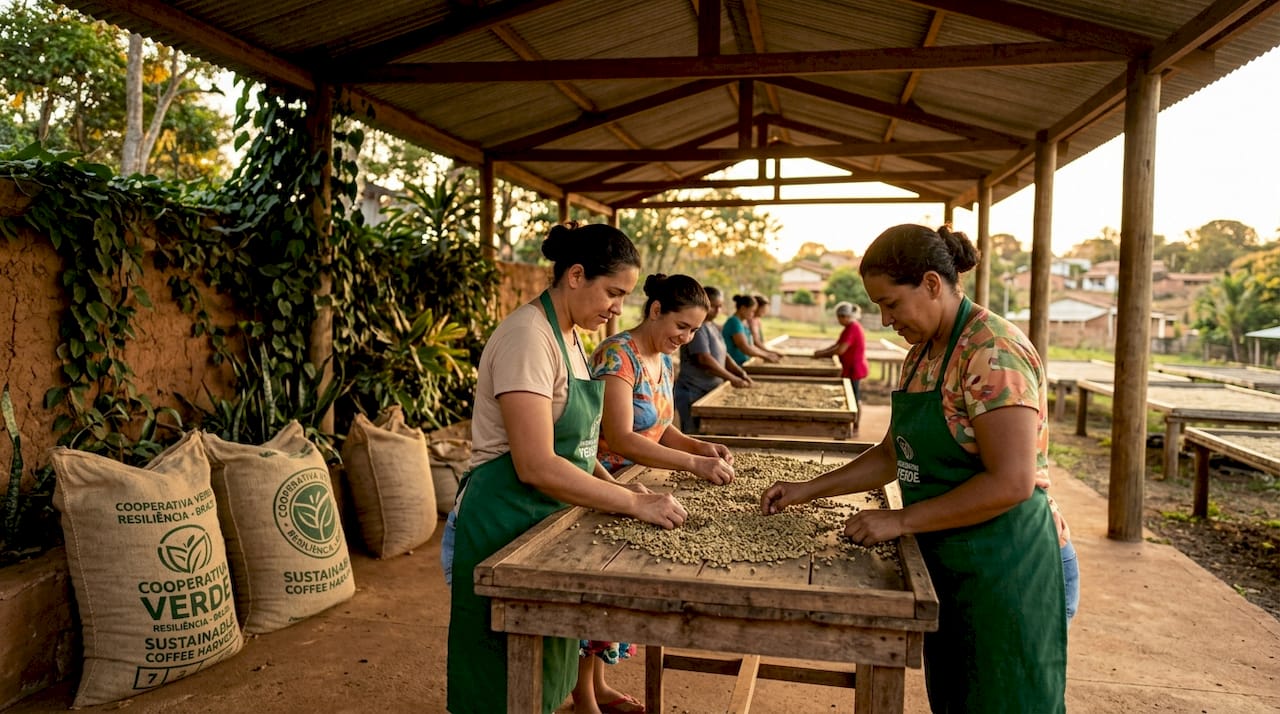
Insetting is carbon mitigation funded and executed inside the coffee supply chain itself, rather than purchasing credits from unrelated projects elsewhere. Think of it as the difference between fixing your own house versus paying someone across town to fix theirs and calling it even. The result is a direct, traceable link between your morning cup and real environmental action at origin.
Cooxupé, Brazil’s largest coffee cooperative, runs one of the clearest examples of this model. Their regenerative coffee project has sequestered 649.94 tons of CO2 across 43.27 hectares, distributing approximately US$21,000 directly to 12 cooperative members. That financial return matters because it proves insetting can reward farmers, not just roasters. The project integrates afforestation with native tree species that enhance both biodiversity and carbon capture, and it works in partnership with GrowGrounds, Clima Café, and Gold Standard certification to keep the process scientifically rigorous.
What separates authentic insetting from marketing spin is the contractual structure. Legitimate insetting projects require explicit ownership of carbon credits, clear payment relationships between the cooperative and buyers, and tradable credits that can be independently verified. Without those elements, “insetting” is just a story on a bag.
Pro Tip: When evaluating a brand’s insetting claim, ask whether they can name the cooperative, the certifying body, and the number of credits issued. If they can’t, the claim is likely organizational marketing rather than field-level impact.
- Insetting keeps carbon finance within the coffee value chain
- Cooxupé’s model links credit sales directly to farmer income
- Gold Standard certification provides independent verification
- Partnerships with GrowGrounds and Clima Café add scientific rigor
2. Carbon removal using coffee residues and biochar
Biochar is charcoal produced by heating organic material, in this case coffee husks, in a low-oxygen environment. When that biochar is applied to soil, it locks carbon away for hundreds to thousands of years. This is not a temporary fix. It is one of the most durable forms of carbon removal available in agriculture today.
Puro.earth’s NetZero Lajinha facility in Brazil is Latin America’s first industrial biochar production plant built on this circular model. The facility works with 400 local smallholder farmers, converting coffee husks that would otherwise decompose and release CO2 into a stable carbon sink. The model is genuinely circular: waste from coffee processing becomes both a climate solution and a soil amendment that improves farm productivity. Farmers gain additional income, and the local economy benefits from job creation at the facility.
Stat to know: Puro.earth issues Carbon Removal Certificates (CORCs) for each verified ton of CO2 removed, with issuance volumes increasing annually as the facility scales. Each CORC represents a long-lived, measurable removal, not a promise. This transparency is exactly what long-lived carbon removals tied to tangible field activities provide: consumer trust grounded in concrete data.
The socio-economic case is just as strong as the environmental one. Smallholder farmers who previously had no market for coffee husks now have a revenue stream. Waste valorization, job creation, and soil health improvement all happen simultaneously, making this one of the most genuinely regenerative models in the coffee sector.
- Coffee husks are converted to biochar instead of decomposing
- Carbon is stored for centuries, not just offset temporarily
- 400 smallholder farmers participate in the Lajinha model
- CORCs provide independently verified, trackable carbon removal
3. Regenerative agroforestry models for carbon neutrality
Regenerative agroforestry goes further than simply planting trees alongside coffee. It rebuilds entire farm ecosystems by integrating shade trees, native plants, and diverse crops in ways that restore soil health, increase biodiversity, and build long-term climate resilience. For coffee, this means farms that actively pull carbon from the atmosphere while producing better-tasting, more resilient beans.
Löfbergs, the Swedish coffee roaster, has built one of the most documented agroforestry sourcing models in the industry. Their program, developed in partnership with GrowGrounds, supports farmers in Brazil in integrating shade trees and native plants into their coffee plots. What makes Löfbergs’ approach stand out is the monitoring layer: GPS-tracked restoration plots and photo documentation create a transparent record of climate impact at the field level. Farmers are not just told to plant trees. They receive climate finance directly tied to verified restoration outcomes, which stabilizes their income and strengthens their relationship with the supply chain.
“The shift from reducing to restoring is the most significant change the coffee industry can make for the climate.” — Löfbergs sustainability team
This model also addresses a gap that most sustainable coffee sourcing programs miss: soil carbon. Healthy, biodiverse agroforestry systems sequester carbon underground in root systems and organic matter, not just in standing trees. That makes the carbon storage more resilient to drought, fire, and disease than monoculture plantations.
Pro Tip: Look for brands that publish GPS coordinates or plot-level monitoring data for their agroforestry programs. That level of specificity signals genuine field-level commitment rather than a broad sustainability claim. You can learn more about how these models work in practice at regenerative agriculture in coffee.
4. Measurement, reduction, and offset models
The measurement-reduction-offset model is the most widely adopted framework for carbon-neutral coffee brands, and it works in exactly that sequence. You cannot credibly offset what you have not first measured, and you cannot call yourself carbon neutral if you are offsetting emissions you could have eliminated. Science-based net-zero pathways require reductions across the value chain before offsets are used, meaning offsets are appropriate only for residual emissions that cannot yet be eliminated. This distinction separates genuine programs from greenwashing.
Pretty Bean Coffee Co applies this framework transparently across their operations. Their process follows three clear steps:
- Measure the full footprint. Pretty Bean calculates emissions across their entire operation, including growing, processing, roasting, packaging, and shipping.
- Reduce where possible. Operational reductions include energy efficiency improvements, responsible supplier selection, and transportation optimization.
- Offset the remainder with verified projects. Remaining emissions are balanced through independently verified reforestation and carbon capture projects, not generic bulk purchases.
The transparency element is what builds consumer trust here. Pretty Bean publishes which offset projects they support and how those projects are verified. That level of openness is rare and worth rewarding with your purchasing decisions. If a brand cannot tell you which offset registry their credits come from, treat that as a red flag. For a deeper look at how offsets fit into the bigger picture, the guide on carbon offsets in coffee breaks it down clearly.
5. Certification-based pathways for sustainable coffee
Certification schemes give consumers a shortcut to trust, but not all certifications are equal. The most credible ones combine science-based standards, independent audits, and field-level monitoring. They also address multiple impact areas simultaneously rather than focusing on a single metric.
The Rainforest Alliance’s Regenerative Agriculture Standard is currently the most rigorous certification pathway for carbon-neutral and sustainable coffee. It covers soil health, biodiversity, water management, and climate resilience in a single framework, verified through independent audits. Lavazza became one of the first major roasters to adopt this standard, with over 70 farms certified in an early Honduras implementation. Consumer-facing product launches in international markets are planned, meaning you will soon be able to buy Lavazza coffee with a regenerative certification on the label.
One nuance worth understanding: project design certification comes before actual carbon credit issuance. A farm can be certified under a standard’s design criteria before any credits have been verified and issued. As a consumer, you want to see evidence of both: the certification and ongoing credit issuance, which confirms the project is delivering real results over time.
| Certification | Focus areas | Key strength |
|---|---|---|
| Rainforest Alliance Regenerative | Soil, biodiversity, climate resilience | Science-based, independently audited |
| Gold Standard | Carbon credits, sustainable development | Rigorous credit issuance process |
| SBTi/FLAG guidance | Value-chain emissions reduction | Requires cuts before offsets |
Certifications also support farmer livelihoods by connecting producers to premium markets and climate finance. That social dimension is what makes certifications in coffee and tea more than just a label. They are a structural tool for rewarding better farming practices.
Key takeaways
The most credible carbon-neutral coffee initiatives combine measurable field-level reductions with transparent verification, whether through insetting, biochar removal, agroforestry, footprint management, or certified standards.
| Point | Details |
|---|---|
| Insetting beats generic offsets | Supply-chain insetting like Cooxupé’s model links carbon finance directly to farmer income and verified field outcomes. |
| Biochar offers durable removal | Puro.earth’s coffee husk biochar locks carbon away for centuries, not just temporarily neutralizes it. |
| Agroforestry restores ecosystems | Löfbergs’ GPS-monitored model rebuilds biodiversity and soil carbon, going beyond simple tree planting. |
| Measurement must come first | Pretty Bean Coffee Co’s three-step model shows that credible offsetting requires full footprint measurement and reduction first. |
| Certifications need ongoing verification | Look for both design certification and active credit issuance to confirm a program is delivering real results. |
Why I think most consumers are looking at carbon-neutral coffee the wrong way
I have spent years reading sustainability reports, certification documents, and supply-chain disclosures, and the single biggest mistake I see eco-conscious coffee drinkers make is treating “carbon neutral” as a binary label. It is not. There is a world of difference between a company that has offset its organizational footprint with bulk-purchased credits and a brand that has invested in verified, field-level carbon sequestration tied to specific farms and farmers.
The initiatives that genuinely excite me are the ones where the carbon story and the farmer story are the same story. Cooxupé’s insetting model and Puro.earth’s biochar facility both do this. Farmers earn more, land is restored, and carbon is removed in ways that can be counted and audited. That circularity is what makes them credible.
My honest concern is that as “carbon neutral” becomes a marketing expectation rather than a genuine commitment, the gap between organizational-level claims and product-specific verified sequestration will widen. Consumers who do not know to ask the difference will be misled. The guide on spotting greenwashing in coffee is a genuinely useful starting point if you want to sharpen your radar. Look beyond the label. Ask which farms, which certifying body, and which credits. The brands doing real work will always have a specific answer.
— LaSaundra
Sip sustainably with EcoVibe Roast
You now know what separates a genuine carbon-neutral coffee program from a feel-good label. So why not put that knowledge to work with every cup you brew? EcoVibe Roast sources its coffee with environmental and social impact at the center of every decision, and every purchase plants mangrove trees and removes ocean-bound plastics. It is a warm hug for both you and Mother Earth, one aromatic cup at a time.

EcoVibe Roast’s single-serve coffee pods make it easy to enjoy rich, responsibly sourced coffee without the waste of traditional brewing. The 60-pack Original Roast is a crowd favorite, delivering bold flavor with the eco-conscious sourcing you care about. Ready to make your coffee ritual count? Explore the full single-serve collection and find your perfect sustainable brew today.
FAQ
What are the main types of carbon-neutral coffee initiatives?
The main types include supply-chain insetting, biochar-based carbon removal, regenerative agroforestry, full-footprint measurement with verified offsets, and science-based certification schemes. Each approach addresses carbon neutrality from a different point in the coffee value chain.
How does insetting differ from buying carbon offsets?
Insetting funds carbon reduction within the coffee supply chain, such as Cooxupé’s cooperative reforestation in Brazil, while offsets purchase credits from unrelated external projects. Insetting creates a direct, traceable link between your coffee purchase and field-level environmental action.
What certifications should I look for in carbon-neutral coffee?
The Rainforest Alliance Regenerative Agriculture Standard and Gold Standard certification are the most rigorous options. Look for brands that show both design certification and active, verified carbon credit issuance, which confirms the program is delivering ongoing results.
Is biochar a reliable form of carbon removal in coffee?
Biochar produced from coffee husks, like Puro.earth’s NetZero Lajinha model, stores carbon for centuries and improves soil health simultaneously. It is considered one of the most durable carbon removal methods available in agricultural supply chains.
How can I tell if a brand’s carbon-neutral claim is genuine?
Ask for the specific farms, certifying body, and carbon registry involved. Credible brands like Pretty Bean Coffee Co publish independently verified offset project details. If a brand cannot name these specifics, the claim is likely organizational-level marketing rather than product-specific impact.


