

You’re standing in the coffee aisle, staring at labels promising fair trade, organic, and sustainability. But which claims are real? 73% of millennials prioritize social responsibility in brands, and coffee offers a daily opportunity to vote with your wallet. This guide cuts through the noise to help you choose ethical coffee that genuinely aligns with your values without sacrificing quality or breaking the bank.
Table of Contents
- Understanding Millennial Values Driving Ethical Coffee Preferences
- What Makes Coffee Ethical? Defining Key Elements and Certifications
- Environmental Impacts of Ethical Coffee Production
- Social Equity and Economic Benefits in Ethical Coffee Supply Chains
- Common Misconceptions About Ethical Coffee
- Making Informed Ethical Coffee Choices: Certifications and Verification
- Linking Ethical Coffee to Health and Lifestyle Benefits
- Conclusion: Aligning Your Coffee Choices with Your Values and Impact
- Discover Sustainable Coffee Choices with EcoVibe Roast
- Frequently Asked Questions About Ethical Coffee and Millennials
Key Takeaways
| Point | Details |
|---|---|
| Millennial Values | Social responsibility and environmental activism drive 73% of millennial purchasing decisions in coffee. |
| Ethical Definition | Fair labor, sustainability certifications like Fair Trade and Organic define truly ethical coffee. |
| Environmental Benefits | Shade-grown coffee reduces deforestation by 30% while preserving biodiversity and lowering carbon emissions. |
| Social Impact | Ethical sourcing increases farmer incomes by 40% through price guarantees and community support programs. |
| Practical Verification | Certifications and transparency tools help verify authentic ethical claims beyond marketing hype. |
Understanding Millennial Values Driving Ethical Coffee Preferences
Your morning brew says more about you than you might think. When 78% say environmental impact influences choices, it’s clear millennials have transformed coffee from a simple beverage into a statement of values. You’re not just buying caffeine. You’re investing in the kind of world you want to live in.
This generation integrates activism into daily purchases. Coffee becomes a vehicle for social change when you select brands that treat farmers fairly and protect ecosystems. Every cup can support environmental conservation or perpetuate harmful practices. The choice is yours.
Millennial values driving ethical coffee extend beyond personal health. You’re connecting your consumption to global outcomes. Consider these driving factors:
- Social responsibility takes priority over brand loyalty or convenience
- Environmental preservation influences where your money goes
- Transparency about sourcing matters more than clever marketing
- Fair labor practices resonate with social justice values
One millennial consumer put it perfectly:
“I won’t compromise my values for convenience. If my coffee dollar can support better farming practices and fair wages, that’s where it goes.”
Understanding these motivations helps you recognize why ethical coffee isn’t a trend. It’s a fundamental shift in how your generation approaches consumption, making every purchase a reflection of deeply held beliefs about sustainability and fairness.
What Makes Coffee Ethical? Defining Key Elements and Certifications
Ethical coffee isn’t marketing speak. It’s a measurable standard backed by verified practices. Three pillars define whether your coffee truly qualifies: fair labor conditions, environmental sustainability, and transparent supply chains. Let’s break down what these actually mean.
Fair labor requires paying farmers prices that cover production costs and provide livable incomes. Fair Trade protects 1.65 million farmers with minimum prices, creating stability in volatile commodity markets. This isn’t charity. It’s basic economic justice.
Environmental sustainability means farming methods that preserve ecosystems rather than destroying them. Organic farming reduces chemical pesticide exposure by up to 90%, protecting both workers and surrounding habitats. These practices rebuild soil health instead of depleting it.
Certifications translate abstract values into concrete verification:
- Fair Trade guarantees minimum prices and funds community development projects
- Organic certification bans synthetic pesticides and requires ecological farming
- Rainforest Alliance focuses on ecosystem protection and biodiversity
- Direct Trade emphasizes relationship-based sourcing with price transparency
Here’s how major coffee certifications and ethical elements compare:
| Certification | Primary Focus | Farmer Benefit | Environmental Impact |
|---|---|---|---|
| Fair Trade | Price floors, community funds | Guaranteed minimum income | Moderate standards |
| Organic | Pesticide-free farming | Premium prices | High ecosystem protection |
| Rainforest Alliance | Biodiversity, worker rights | Training, better conditions | High habitat preservation |
| Direct Trade | Transparent relationships | Above-market prices | Varies by relationship |
Transparency matters because over 60% of ethical coffee brands use traceability to prove their claims. You can trace your beans from specific farms to your cup, verifying that ethical promises translate to real practices.
Pro Tip: Look for multiple certifications on the same product. A coffee with both Fair Trade and Organic labels meets stricter combined standards than either alone.
Fair Trade certification details reveal how cooperatives use premium payments to build schools and healthcare facilities. Understanding Fair Trade certification principles helps you evaluate whether brands genuinely support farmers or just borrow ethical language for marketing.
Environmental Impacts of Ethical Coffee Production
Your coffee choice ripples through ecosystems thousands of miles away. Conventional coffee farming often means cleared forests, chemical runoff, and habitat destruction. Ethical production flips this script entirely.
Shade-grown coffee reduces deforestation by up to 30% by maintaining tree canopy instead of clear-cutting for full sun plantations. These trees provide habitat for migratory birds, prevent soil erosion, and sequester carbon. You’re essentially funding forest preservation with every ethical coffee purchase.
Sustainable farms preserve natural habitats and soil health through practices that work with nature rather than against it. Composting, natural pest control, and water conservation become standard operating procedures. The result? Coffee farms that sustain biodiversity instead of creating agricultural deserts.
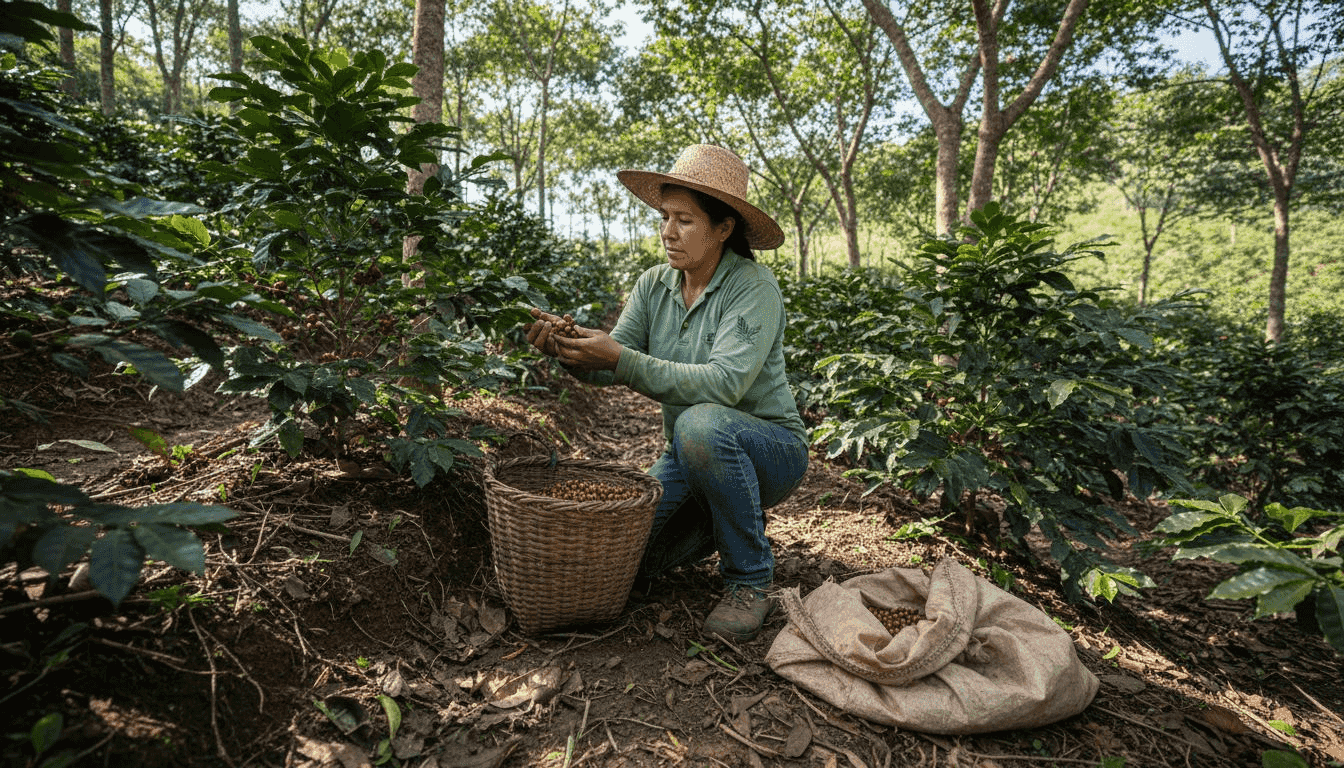
Carbon footprint matters too. Ethical farming reduces emissions compared to conventional farming through renewable energy use, reduced chemical inputs, and improved soil carbon storage. Some ethical coffee brands even achieve carbon-neutral or carbon-negative operations.
The environmental benefits of ethical coffee include:
- Preserved water quality through eliminated chemical runoff
- Protected pollinator populations essential for coffee flowering
- Maintained soil fertility for long-term farm viability
- Reduced greenhouse gas emissions across the supply chain
- Enhanced biodiversity supporting ecosystem resilience
Organic coffee environmental benefits extend beyond the farm itself. Organic certification requires buffer zones protecting nearby ecosystems from contamination. These zones become wildlife corridors connecting fragmented habitats.
Pro Tip: Check if your coffee brand offsets emissions through reforestation or renewable energy. Many ethical companies plant trees or remove ocean plastic with each purchase, multiplying your environmental impact.
When you choose sustainably farmed coffee, you’re not just reducing harm. You’re actively supporting farming systems that regenerate ecosystems, proving that agriculture can enhance rather than degrade the environment.
Social Equity and Economic Benefits in Ethical Coffee Supply Chains
Behind every cup sits a farmer whose livelihood depends on fair compensation. Conventional coffee supply chains trap producers in poverty through price volatility and exploitative middlemen. Ethical sourcing rewrites these economic relationships entirely.
Fair Trade guarantees price floors mitigating market volatility, providing stability when global coffee prices crash. Farmers can plan for the future instead of living crisis to crisis. This economic security transforms communities.
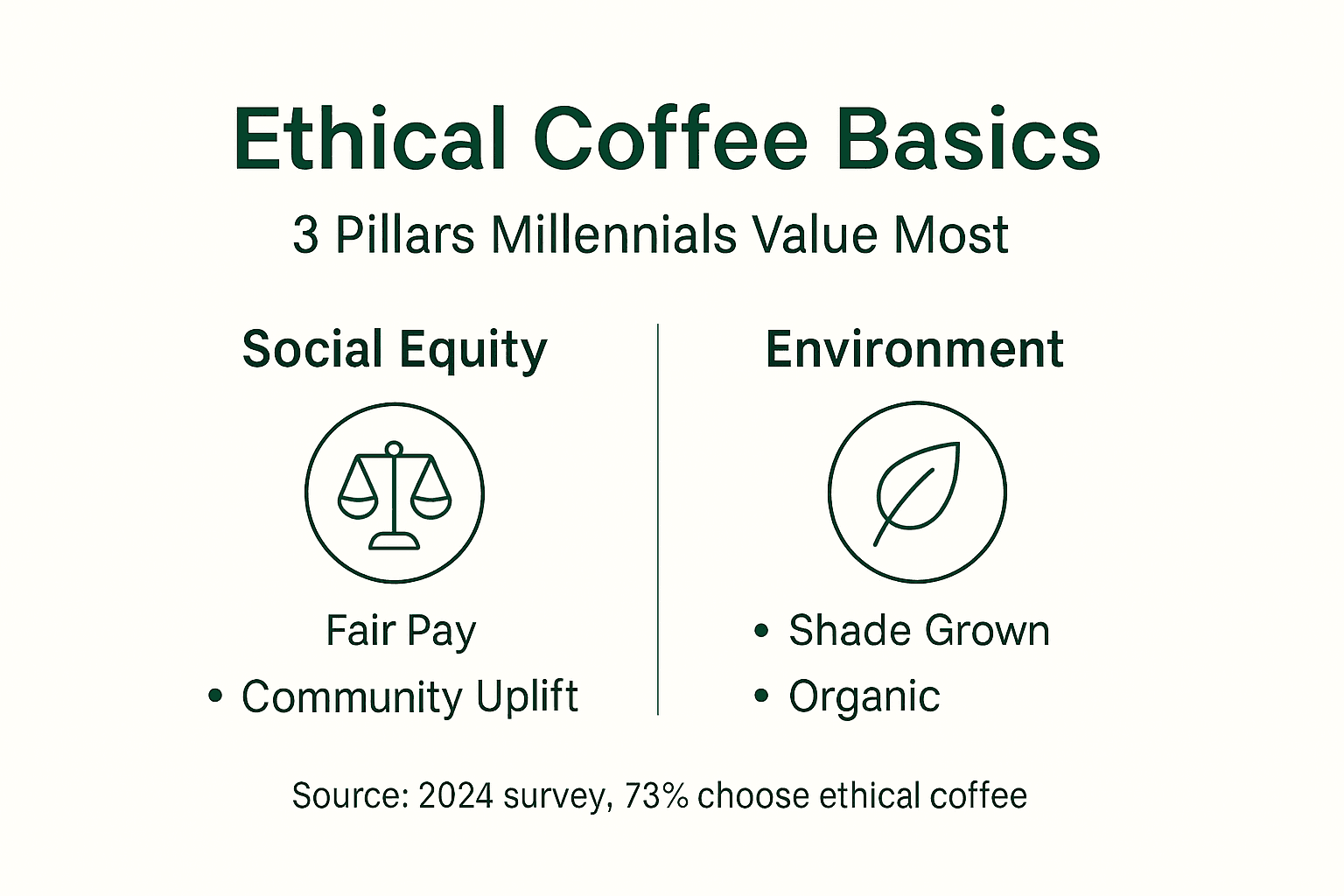
The numbers tell a powerful story. A 40% income increase was demonstrated in a Costa Rican cooperative after transitioning to Fair Trade certification. That’s not marginal improvement. That’s life-changing money funding education, healthcare, and improved farming infrastructure.
Ethical sourcing supports better labor practices and community welfare through requirements that go beyond price. Safe working conditions, no child labor, and democratic cooperative structures become non-negotiable standards. Your purchase dollars enforce these protections.
Consider how social equity in coffee supply chains creates ripple effects:
- Guaranteed minimum prices provide income stability for farm families
- Community development premiums fund schools, clinics, and infrastructure
- Cooperative structures give farmers collective bargaining power
- Technical training improves yields and quality without increasing costs
- Access to credit helps farmers invest in sustainable farming equipment
- Women’s empowerment programs address gender inequality in coffee regions
Ethical coffee and farmer welfare demonstrates how economic justice and environmental sustainability reinforce each other. Farmers with stable incomes can invest in conservation practices. Short-term survival pressure no longer forces harmful shortcuts.
One Fair Trade cooperative leader explains:
“Before certification, we survived harvest to harvest with no savings. Now we plan years ahead, send our children to university, and invest in organic practices that protect our land for future generations.”
Your ethical coffee purchase doesn’t just buy beans. It funds economic systems that value human dignity and community wellbeing over maximum profit extraction, proving that commerce can uplift rather than exploit.
Common Misconceptions About Ethical Coffee
You’ve probably heard that ethical coffee costs too much or tastes worse than conventional options. Let’s examine what the data actually shows versus what marketing myths suggest.
Myth one: ethical coffee is prohibitively expensive. Reality? Price premiums average only 5-15% above conventional coffee. For a daily cup, that’s pennies. You likely spend more on flavor syrups without thinking twice.
Myth two: certifications mean inferior taste. Actually, over 50% associate ethical coffee with better taste and quality. Why? Ethical farming often means higher elevation, careful processing, and selective harvesting. These factors improve flavor profiles significantly.
Myth three: you can’t verify ethical claims beyond certifications. False. Traceability increases consumer trust through blockchain, QR codes, and detailed sourcing stories. Many brands now let you track beans to specific farms, providing transparency that certifications alone can’t match.
Let’s clear up other common confusion:
- Not all ethical coffee comes from small farms; some large estates implement excellent sustainability practices
- Single certifications don’t guarantee every ethical standard; look for multiple verifications
- Direct Trade isn’t automatically superior to Fair Trade; both have strengths depending on context
- Organic certification focuses on pesticides but doesn’t automatically ensure fair labor practices
Pro Tip: Compare price per ounce rather than package price. Ethical coffee’s modest premium often disappears when you consider you’re buying higher quality beans requiring less per brew for full flavor.
The certification confusion runs deep. Some assume any certification means perfection across all ethical dimensions. In reality, each certification addresses specific standards. Fair Trade emphasizes economics, Organic focuses on environment, and Rainforest Alliance balances both with social factors.
You might worry that ethical claims are just greenwashing. Valid concern. That’s why verification matters. Look for third-party certification logos, detailed sourcing information, and brands willing to share supply chain data. Genuine ethical companies welcome scrutiny.
Addressing these misconceptions removes barriers preventing you from choosing coffee aligned with your values. The modest cost difference and often superior quality mean ethical coffee isn’t a sacrifice. It’s an upgrade that happens to support better farming systems.
Making Informed Ethical Coffee Choices: Certifications and Verification
You’re ready to buy ethical coffee, but how do you separate genuine products from greenwashed marketing? 35% of U.S. millennials seek certifications pre-purchase, showing that verification matters to your generation. Let’s build your decision framework.
Certifications like Fair Trade and Organic have verified standards enforced through regular audits. These aren’t self-awarded badges. Independent organizations inspect farms and supply chains before granting certification. This third-party verification gives you confidence beyond brand promises.
Transparency tools help verify impact through technology that tracks coffee from farm to roaster. Scan a QR code and see where your beans grew, who farmed them, and what premiums were paid. This visibility makes accountability tangible.
Your verification checklist should include:
- Multiple recognized certifications on packaging
- Specific farm or cooperative names rather than vague “ethically sourced” claims
- Detailed sourcing stories on brand websites
- Transparent pricing information showing farmer payments
- Membership in accountability organizations like B Corp
Here’s how to evaluate certification reliability:
| Certification Type | Verification Method | Update Frequency | What It Guarantees |
|---|---|---|---|
| Fair Trade USA | Annual farm audits | Yearly | Minimum prices, labor standards |
| USDA Organic | Third-party inspection | Annual | No synthetic pesticides or GMOs |
| Rainforest Alliance | Multi-year certification cycle | Every 3 years | Ecosystem protection, worker welfare |
| B Corp | Comprehensive impact assessment | Every 3 years | Overall business ethics and transparency |
Understanding coffee certifications helps you prioritize what matters most to you. If pesticide exposure concerns you most, prioritize Organic. If farmer income is your top value, focus on Fair Trade. Many ethical coffees carry multiple certifications addressing various concerns simultaneously.
Verify Fair Trade claims by checking certification databases online. Fair Trade USA maintains searchable records of certified producers. If a brand claims Fair Trade but you can’t verify it, that’s a red flag.
Pro Tip: Watch for vague ethical language without specific certifications. Terms like “responsibly sourced” or “ethical” alone mean nothing without verification. Legitimate ethical brands proudly display specific certification logos.
Learn verification of ethical product claims principles that apply across product categories. The same verification thinking that works for coffee helps you evaluate ethical claims on everything from clothing to household goods.
Armed with verification tools, you can confidently choose coffee knowing your purchase genuinely supports the values you care about rather than funding clever marketing disguised as ethics.
Linking Ethical Coffee to Health and Lifestyle Benefits
Your coffee choice affects more than farmers and forests. It impacts your personal health too. Ethical coffee often means cleaner, healthier beans that align with wellness-focused lifestyles many millennials embrace.
Organic farming cuts pesticide exposure by up to 90%, keeping synthetic chemicals out of your morning routine. Conventional coffee ranks among the most heavily sprayed crops globally. Every sip of non-organic coffee potentially includes pesticide residues.
Millennials perceive ethical coffee as healthier, and for good reason. Organic certification bans not just pesticides but also synthetic fertilizers and GMOs. The result? Cleaner beans with higher antioxidant levels from nutrient-rich soil.
Ethical coffee aligns with wellness and environment values in ways that resonate with holistic health approaches. You’re not compartmentalizing your values, choosing between personal health and environmental responsibility. Ethical coffee delivers both simultaneously.
Consider these health-related benefits:
- Eliminated pesticide residues reduce toxic load on your body
- Higher antioxidant content from healthy soil provides better nutrition
- Shade-grown beans often contain more complex flavor compounds and beneficial nutrients
- Organic certification ensures no harmful additives during processing
- Cleaner growing conditions mean fewer contaminants reaching your cup
Sustainable farming practices support broader environmental health that circles back to human wellbeing. Preserved water quality, reduced air pollution, and protected ecosystems create healthier communities in coffee-growing regions. Your health connects to the planet’s health.
Ethical coffee fits perfectly into lifestyle choices emphasizing whole foods, environmental consciousness, and mindful consumption. It’s not just about what you put in your body but also about the systems you support with your purchasing power.
The wellness connection extends to mental health too. Many millennials report feeling better knowing their purchases align with their values. That psychological benefit, that sense of living in integrity with your beliefs, adds its own form of wellbeing to your morning ritual.
Choosing ethical coffee becomes part of a comprehensive approach to health that recognizes connections between personal wellness, social justice, and environmental sustainability. Your body and your conscience both benefit.
Conclusion: Aligning Your Coffee Choices with Your Values and Impact
You now understand why ethical coffee resonates so powerfully with millennial values. It’s not complicated. Your generation refuses to separate consumption from consequences, demanding that daily choices reflect deeper commitments to sustainability, fairness, and health.
Ethical coffee delivers on all three fronts. Certifications and transparency ensure your purchases genuinely support responsible farming rather than funding greenwashed marketing. The modest price premium becomes insignificant when weighed against environmental protection, farmer welfare, and personal health benefits.
Key principles to remember:
- Look for verified certifications from recognized organizations
- Use transparency tools to verify claims beyond marketing language
- Understand that ethical coffee often delivers superior quality, not sacrifice
- Recognize your purchasing power as a tool for positive change
- Connect your coffee choice to broader lifestyle values about sustainability
You’re not just buying coffee. You’re voting for farming systems that regenerate ecosystems, economic models that honor human dignity, and supply chains that value transparency over exploitation. Each cup becomes a small but meaningful act of activism.
The future of coffee depends on consumers demanding better practices. Your generation’s willingness to prioritize ethics alongside quality is already transforming the industry. Keep that momentum going. Choose coffee that reflects who you are and the world you want to create.
Discover Sustainable Coffee Choices with EcoVibe Roast
Ready to put these principles into practice? EcoVibe Roast makes it easy to find coffee that matches your values without compromise. We source exclusively from farms meeting strict environmental and social standards, proving that exceptional taste and ethical sourcing go hand in hand.

Explore the latest sustainability trends in coffee shaping the industry in 2026. Our detailed guides help you stay informed about innovations making coffee even more sustainable. Use our sustainable coffee checklist to evaluate any coffee brand’s ethical credentials.
Discover our ethical single-serve coffee pods that combine convenience with sustainability. Every purchase plants mangrove trees and removes ocean-bound plastics, multiplying your positive impact. Join thousands of conscious consumers choosing coffee that reflects their values while enjoying premium quality.
Frequently Asked Questions About Ethical Coffee and Millennials
How can I verify ethical coffee claims beyond certifications?
Use brand transparency tools like QR codes that trace beans to specific farms and cooperatives. Check if the company publishes detailed sourcing reports or belongs to accountability organizations like B Corp. Contact brands directly asking for supply chain information; ethical companies welcome these questions and provide detailed answers.
Does ethical coffee really cost significantly more than regular coffee?
No, price premiums average just 5-15% above conventional coffee, often less than a dollar per bag. When calculated per cup, the difference becomes pennies. Many ethical coffees actually provide better value because higher quality beans require less per brew to achieve full flavor, offsetting the modest initial premium.
Why does ethical coffee often taste better than conventional options?
Ethical farming practices typically occur at higher elevations with shade cover, producing slower bean maturation and more complex flavors. Careful hand-harvesting selects only ripe cherries rather than strip-picking everything. Organic soil health and ecosystem biodiversity contribute nutrients and microclimates that enhance taste profiles naturally.
How can millennials support ethical coffee beyond just purchasing?
Share information about ethical coffee with your network to expand awareness and demand. Support legislation requiring supply chain transparency in coffee imports. Visit coffee farms through ethical tourism when possible to understand production firsthand. Pressure conventional brands to improve practices through social media campaigns and direct feedback.
Do all organic certifications guarantee fair labor practices?
No, organic certification focuses exclusively on environmental standards like pesticide elimination and soil health. It doesn’t automatically ensure fair wages or safe labor conditions. Look for products carrying both Organic and Fair Trade or Rainforest Alliance certifications to address both environmental and social dimensions simultaneously.
Recommended
- Why Choose Ethical Coffee: Impact on Daily Life – EcoVibe Roast
- Conscious Coffee Drinkers: Eco Impact and Ethics – EcoVibe Roast
- Sustainability Trends in Coffee 2026: Impact on Ethical Choices – EcoVibe Roast
- Why Support Eco-Friendly Coffee & Tea in 2026: Cut 50% Carbon – EcoVibe Roast
- Smart Coffee Machines with AI — Top 5 Picks & Future Trends
- Why Buy Ethical Beachwear: Stylish Impact Explained


