

TL;DR:
- The environmental impact of your coffee or tea mainly occurs at the farm stage, not in your kitchen.
- Building a sustainable workflow requires careful sourcing, proper certification understanding, and responsible disposal practices.
Every aromatic cup of coffee or tea you brew carries a story that starts long before the water boils. And here’s the part that surprises most eco-conscious drinkers: the environmental weight of that story is heaviest at the farm, not in your kitchen. Labels like “natural” and “eco-friendly” can feel reassuring, but they don’t always tell the full truth. This guide cuts through the greenwash and walks you through a start-to-finish sustainable beverage workflow, covering what to source, how to brew, and how to verify that your daily ritual is genuinely good for the planet and the people who grow what you love.
Table of Contents
- Understanding the hidden impacts of your beverage choices
- What you need: Materials, certifications, and pre-checks
- Step-by-step: How to brew and serve sustainably
- How to verify, adapt, and maximize your impact
- The uncomfortable truth about sustainable beverage workflows
- Ready to create your sustainable beverage workflow?
- Frequently asked questions
Key Takeaways
| Point | Details |
|---|---|
| Cultivation impact dominates | The biggest environmental footprint in coffee and tea comes from how the crops are grown and processed. |
| Certifications are helpful, not perfect | Fairtrade and Rainforest Alliance labels matter, but always dig deeper into real practices and supply chain transparency. |
| Sustainability is ongoing | Adjust your beverage workflow over time by measuring, verifying, and seeking continuous improvement. |
| Small changes add up | Simple actions like saving water during brewing and reducing waste can greatly amplify environmental impact when done consistently. |
Understanding the hidden impacts of your beverage choices
You might assume the biggest sustainability issue in your coffee or tea habit is the cup you throw away. But the data tells a different story. LCA (Life Cycle Assessment) research on Sri Lankan tea found that cultivation dominates the environmental impact, with smallholder orthodox production generating around 3,304 kg CO2 equivalent per tonne and estate CTC (a machine-cut processing method) at approximately 2,894 kg CO2 equivalent per tonne. The farm stage, not your kitchen, is where the biggest decisions get made.
This is why understanding sustainable agriculture for coffee and tea is so foundational. How a crop is grown, how workers are treated, how land is managed — these choices ripple forward through every sip.
The broader beverage industry is making measurable progress. A 2025 BIER study tracking more than 1,600 facilities found that the industry achieved 8% production growth from 2020 to 2024 while still cutting water use, energy consumption, and emissions. That’s meaningful progress! But it also means there’s still real room to improve, especially upstream where smallholder farmers often lack the resources to shift quickly.
Downstream factors like packaging and transportation are smaller in their overall climate footprint, but they’re far from negligible. Single-use plastics, excessive cardboard, and long-haul air freight all add up over millions of orders. Exploring how circular economy principles apply to beverages is one of the clearest ways to start reducing that downstream drag. And keeping an eye on sustainability trends in coffee and tea for 2026 helps you stay one step ahead of the curve.
| Impact stage | Key factor | Relative footprint |
|---|---|---|
| Cultivation | Land use, fertilizers, water | Highest |
| Processing | Energy, water, waste | High |
| Packaging | Materials, recyclability | Medium |
| Transport | Distance, mode | Medium |
| Brewing | Energy, water | Low to medium |
| Disposal | Compostability, landfill | Low |
Knowing which stage carries the most weight helps you make sharper choices rather than spreading your effort too thin.
Having set the stakes, let’s break down what you need for a sustainable workflow.
What you need: Materials, certifications, and pre-checks
Building a sustainable beverage workflow starts with knowing what’s actually in your hands before you ever reach for a scoop or a filter. Certifications are one of your strongest tools here, but they come with important nuances you need to understand.
Here’s a side-by-side look at the four major certification schemes you’ll encounter:
| Certification | What it guarantees | What it doesn’t guarantee |
|---|---|---|
| Fairtrade | Minimum price floor, community premiums | Full living wage for all workers |
| Rainforest Alliance | Biodiversity, soil health, water management | Minimum price floor |
| Bird-Friendly (Smithsonian) | 40% shade canopy minimum plus Organic certification | Worker wages or income stability |
| Direct Trade | Relationship-based sourcing, higher pay potential | Third-party auditing or standardized oversight |
As Ethical Consumer’s research on certification schemes makes clear, Fairtrade offers a price floor but has limited direct wage impact for workers, while Rainforest Alliance leads on environmental standards but offers no price guarantee. Neither is perfect on its own. The Rainforest Alliance also recently deepened its biodiversity and soil health standards with a new Regenerative Agriculture Certification, which is a real step forward for coffee and tea farming.
There’s another detail that often gets overlooked: mass balance (a supply chain accounting method that allows certified and non-certified materials to be blended). This means a product can carry a certification logo even if not every bean or leaf was sourced from a certified farm. Always read labels carefully and look for “100% certified” claims where possible.
Here’s a quick checklist to pre-screen your options before you buy:
- Packaging type: Is it recyclable, compostable, or reusable? What does the brand actually recommend for disposal?
- Transparency: Does the brand publish sourcing details, farm names, or impact reports?
- Traceability: Can you trace the product back to a specific region, cooperative, or farm?
- Certifications: Are they independently audited? Do they cover environmental AND social standards?
- Origin specificity: Single-origin products are generally easier to trace and verify than blends.
Digging into how certifications actually drive sustainability in the coffee and tea world is a great next step for sharpening your sourcing instincts. You’ll also find real-world examples of ethical sourcing done right that help you see what genuine transparency looks like in practice.
Pro Tip: When a brand claims sustainability credentials, look for a named third-party auditor on the certification page, not just a logo. A logo without a verifiable audit trail is a yellow flag.
Once you’ve sourced the right ingredients and prepped your workflow, it’s time to execute the process in practice.
Step-by-step: How to brew and serve sustainably
The good news is that building a sustainable brewing practice at home or in a small café is genuinely doable, and it doesn’t have to feel like a compromise on flavor or convenience. Here’s a clear workflow to follow:
-
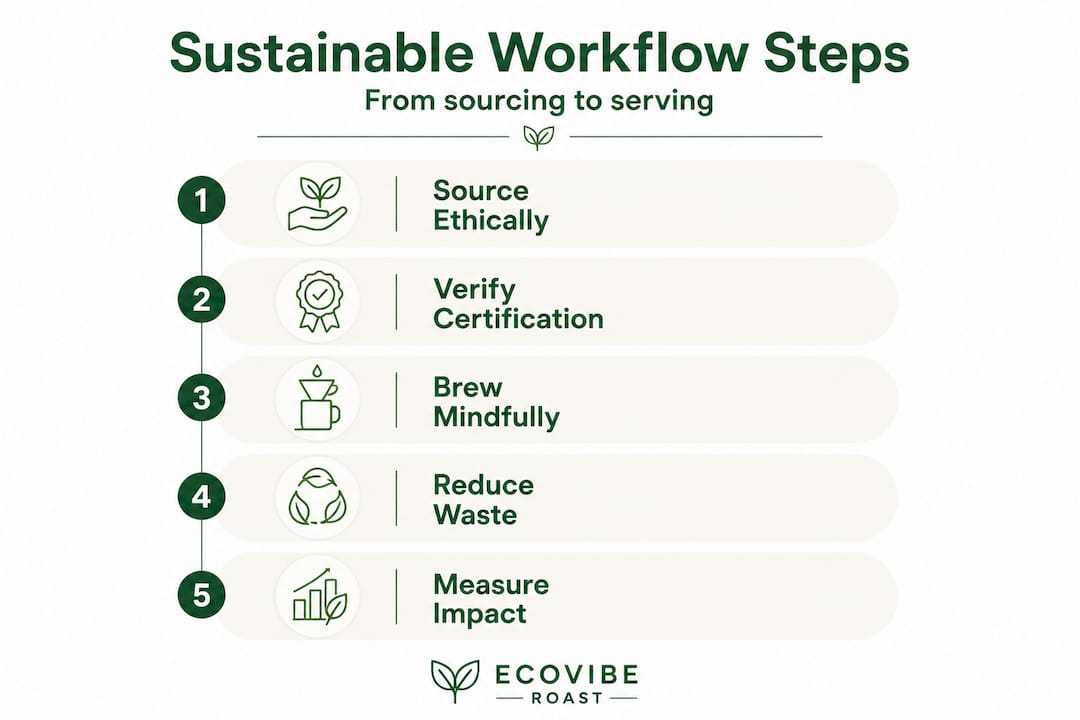
Choose your beans or leaves with intention. Start every purchase by applying your certification checklist. Prioritize products with transparent supply chains and multiple layers of verification.
-
Use only the water you need. Heating excess water wastes both water and energy. A simple kettle with volume markings helps you boil just enough. This sounds small, but saving a liter of water per day adds up significantly over a full year.
-
Optimize your brewing temperature. Most coffee brews best at 195 to 205°F, and green tea shines at lower temperatures around 160 to 180°F. Using the right temperature prevents bitter over-extraction and means you’re not overheating unnecessarily.
-
Handle spent grounds and leaves responsibly. Coffee grounds are rich in nitrogen and make excellent compost. Tea leaves can also be composted or used as garden mulch. If you’re not composting at home, check whether your city has an organic waste collection program.
-
Rethink your packaging disposal. Not all packaging labeled “compostable” can break down in a home compost bin. As LCA research confirms, industrial composting facilities are often required for certified compostable packaging to actually break down properly. Check out the details on compostable coffee packaging before tossing anything in the green bin.
-
Choose reusable accessories. Swap paper filters for a metal mesh or unbleached cloth filter. Use a reusable travel cup instead of a to-go cup. Look into upcycled packaging and accessories for coffee and tea to find creative, low-waste options.
-
For small cafés: batch prep and serve smarter. Brewing in larger batches during peak hours reduces energy cycling. Switching to a keep-cup incentive program dramatically reduces disposable cup waste. Consider eco-friendly packaging solutions designed for food service settings.
“The biggest win is setting up habits — saving a liter of water per day adds up over a year.”
Pro Tip: Not all “compostable” packaging can go in your home compost bin. Some require industrial composting facilities that reach much higher temperatures. Always check your local guidance, and explore the 2026 sustainable packaging guide for beverages for the latest disposal standards.
With your workflow in place, you’ll want to verify, adapt, and track your impact.
How to verify, adapt, and maximize your impact
Putting a good system in place is satisfying, but the most impactful thing you can do is keep measuring and adjusting. Sustainability isn’t a destination; it’s an ongoing practice.
| What to track | How to measure it | Green flag |
|---|---|---|
| Certification authenticity | Look up brand on certifier’s database | Listed as active, audited |
| Water use | Count liters per brew session | Consistent reduction over time |
| Energy use | Monitor kettle/machine wattage and frequency | Shorter heat-up cycles, lower wattage appliances |
| Packaging waste | Count non-recyclable pieces per week | Trending toward zero |
| Supply chain visibility | Check for named farms, annual reports | Named origins, published data |
Here are some signs you might be misplacing your energy:
- Overvaluing certification logos without checking whether the product uses mass balance accounting
- Focusing entirely on packaging while ignoring the much larger upstream agricultural impacts
- Ignoring your brew setup because energy and water at the cup stage still matter, even if they’re smaller
- Skipping research on smaller brands that may offer superior transparency but less visible certification coverage
Emerging tools like blockchain and AI-driven supply chain monitoring are making traceability more powerful. As traceability technology continues to advance, near-complete supply chain transparency is becoming achievable, though adoption remains uneven, especially among smaller producers and importers. Tools like these also connect directly to tea supply chain transparency, giving you real power to verify what you’re buying.
The social dimension deserves equal attention. Fairtrade-certified products have shown higher farmer incomes and improved price stability across 10 and 21 studies respectively, with 90% of long-term economic studies showing positive effects. But tea workers specifically often still fall below living wage benchmarks, which means looking for additional wage commitments from brands is worth your time. You can also learn more about efficient and sustainable beverage serving to round out your approach.
True stewardship means measuring, reporting to yourself honestly, and iterating. Think of it as tending a garden, not flipping a switch.
The uncomfortable truth about sustainable beverage workflows
Here’s something we’ve learned from years inside this industry: certifications are essential, but they represent a floor, not a ceiling. They’re the minimum acceptable standard, not proof of excellence. Treating a certification logo as a finish line is one of the most common mistakes even passionate eco-conscious consumers make.
Direct Trade is a good example of this nuance. It often delivers higher prices to farmers and creates genuine relationships. But Direct Trade lacks standardized audits and relies heavily on trust between roasters and farms, with no independent verification required. Bird-Friendly certification, which we love for its biodiversity benefits, requires at least 40% shade canopy coverage plus a full Organic certification, making it genuinely meaningful. But it tells you nothing about worker wages.
The bigger picture? Voluntary standards can only do so much without regulatory muscle behind them. Consumer activism, pushing brands to publish verified data and pressuring governments to set binding standards for imported goods, is where lasting change comes from. Look at the limits of certifications and you’ll see that the brands making the most meaningful progress are the ones going beyond the minimum, not just meeting it.
“No workflow is truly sustainable if it stops at the consumer — systems change matters.”
Pro Tip: Don’t just trust a label. Ask how and where the sustainability claims are verified. A brand willing to answer that question openly is a brand worth supporting.
Ready to create your sustainable beverage workflow?
You now have the knowledge to brew with real intention, from field to cup. And the good news is, making your sustainable workflow tangible starts with one great product choice.

At EcoVibe Roast, every product is selected with your values in mind. Try our vibrant organic Hibiscus Berry Tea for a naturally sweet, caffeine-free option that fits beautifully into any low-waste routine. Or grab our convenient single serve coffee pods for a low-effort, high-flavor brew that doesn’t compromise on sustainability. And when you shop with us, you’re also supporting real ecological action — every purchase helps plant mangrove trees and remove ocean-bound plastics. See exactly what that means for the planet on our environmental impact commitments page. Your cup can genuinely be a warm hug for both you and Mother Earth.
Frequently asked questions
Which certification is most reliable for sustainable tea or coffee?
No single certification covers everything perfectly. Fairtrade guarantees a price floor while Rainforest Alliance leads on environmental standards, so looking for products with multiple overlapping certifications gives you the most confidence.
How can I verify a product’s sustainability claim?
Look for real third-party certifications with named auditors, review annual brand impact reports, and use supply chain traceability apps. Blockchain and AI tools are increasingly helping consumers trace products all the way back to the farm.
Does buying certified coffee or tea really help farmers?
Yes, with some limits. Fairtrade shows higher incomes and price stability for farmers across dozens of studies, but many tea workers still fall below full living wage thresholds, so certified plus wage-committed brands are the strongest choice.
Is compostable packaging always better for the environment?
Not automatically. Some compostable packaging only breaks down properly in industrial composting facilities, not home bins. Always check local composting infrastructure before assuming a “compostable” label means it’s truly low-impact in your specific situation.
Recommended
- Master workflow to reduce coffee waste sustainably in 2026 – EcoVibe Roast
- Sustainable packaging in beverages: eco-conscious guide 2026 – EcoVibe Roast
- Master Eco-Conscious Coffee Making Workflow for Sustainability – EcoVibe Roast
- Sustainability trends 2026: Smarter, greener choices for coffee & tea – EcoVibe Roast
- How to grow your home cooking business sustainably
- Vineyards & Sustainability - Res Fortes


