

TL;DR:
- Choosing certified coffee or tea supports environmental and social sustainability through reputable standards.
- Research brands for transparency and avoid greenwashing by verifying certifications, impact reports, and sourcing details.
Your morning cup is more than a ritual that tantalizes your taste buds and sparks your day. It’s a vote. Every time you choose a coffee or tea brand, you’re sending a signal to farmers, supply chains, and corporations about what values matter to you. The challenge is that the marketplace is flooded with “eco-friendly” and “sustainable” claims that can make it genuinely hard to know which products actually move the needle. This guide cuts through that noise and gives you a clear, practical roadmap for turning your daily brew into a force for real environmental and social change.
Table of Contents
- Understanding certifications and what they really mean
- How to research brands and avoid greenwashing
- Prioritizing packaging and lifecycle impact
- Making your purchase count: Everyday habits for real impact
- The surprising truth about sustainable purchases
- Ready to make a difference with your next cup?
- Frequently asked questions
Key Takeaways
| Point | Details |
|---|---|
| Certifications matter | Third-party certifications like Rainforest Alliance and Fairtrade signal concrete environmental and social benefits. |
| Demand transparency | Go beyond labels by looking for open reporting on sourcing, supply chains, and environmental outcomes. |
| Packaging counts | The most sustainable coffee or tea uses recyclable, compostable, or upcycled materials to minimize waste. |
| Habits add up | Small, consistent choices amplify your daily positive impact far beyond one-off purchases. |
| Support systemic change | Advocacy, responsible buying, and demanding better industry standards lead to genuine long-term improvement. |
Understanding certifications and what they really mean
With the importance of your purchases established, let’s break down what those “eco-friendly” or certified labels actually guarantee and where their limitations lie.
Walking down the coffee aisle or browsing online, you’ve likely spotted a cluster of logos: a green frog, a blue circle, a gold-and-black emblem. These aren’t just decoration. They represent third-party verification systems that hold farms, cooperatives, and supply chains to documented standards. Understanding coffee certifications explained is genuinely one of the most powerful things you can do as a conscious consumer.
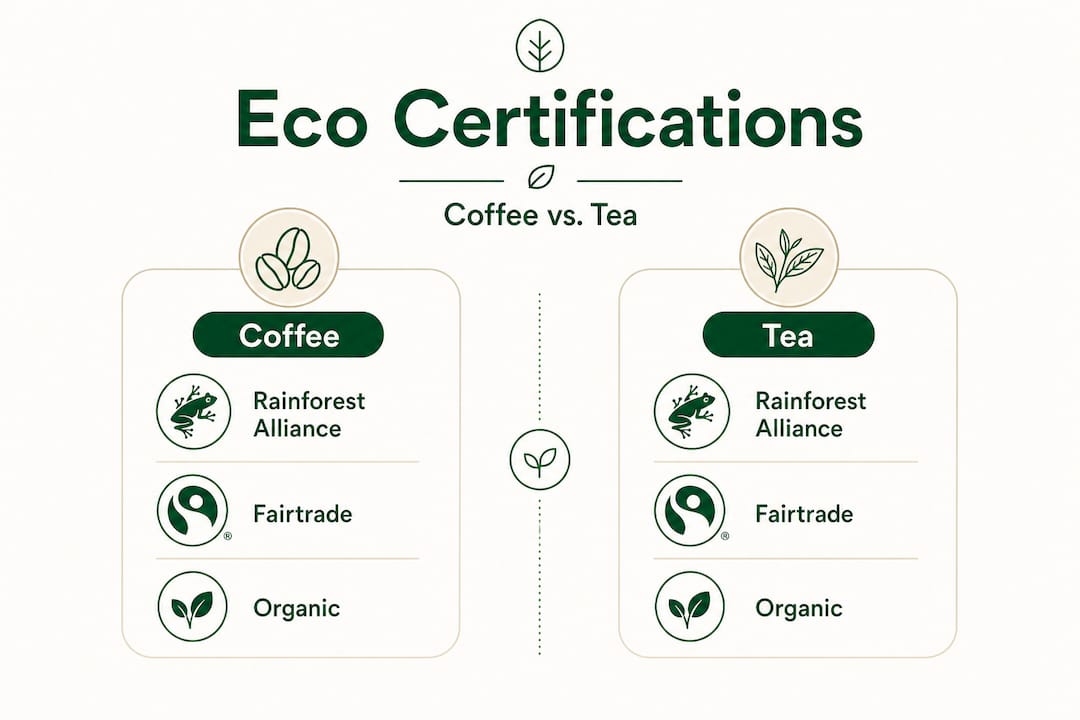
The three certifications you’ll encounter most often are Rainforest Alliance, Fairtrade, and Organic. Each one tackles sustainability from a slightly different angle, and knowing the difference helps you match your purchase to your priorities.
| Certification | Key Focus | Environmental Benefit | Social Benefit |
|---|---|---|---|
| Rainforest Alliance | Biodiversity and climate resilience | Protects ecosystems, reduces deforestation | Supports worker rights and community programs |
| Fairtrade | Fair wages and fair prices | Funds environmental projects through premiums | Guarantees minimum price floors for farmers |
| Organic | Chemical-free farming | Improves soil health, reduces pesticide runoff | Reduces farmer exposure to toxic chemicals |
Certified sustainable coffee and tea standards ensure biodiversity, soil health, climate resilience, and fair labor across participating farms. That’s a meaningful promise. Rainforest Alliance certification, for example, requires farms to protect waterways, maintain shade-grown canopy coverage to support bird species, and limit or eliminate synthetic chemicals entirely.
Fairtrade takes a different but equally vital approach. Its premium model means a portion of every purchase goes directly into a community fund that farmers and cooperatives vote on how to spend. Remarkably, over 122 studies confirm positive economic, social, and environmental outcomes from Fairtrade certification. Those projects often include reforestation, clean water infrastructure, and climate adaptation training.
Organic certification focuses heavily on soil and water health. Farms that avoid synthetic herbicides and fertilizers tend to produce richer biodiversity, healthier soil microbiomes, and cleaner nearby waterways. For tea in particular, where growing regions overlap with ecologically fragile highland ecosystems, organic practices can be genuinely transformative.
That said, learn to understand how certifications drive change rather than treating any single logo as a perfect guarantee. Certifications are strong starting points, not finish lines.
- Rainforest Alliance covers farms of all sizes but requires ongoing audits to maintain credibility
- Fairtrade is strongest when cooperatives are empowered to invest premiums transparently
- Organic certification is expensive to obtain, which can exclude small farmers who already practice organic methods but lack resources to certify
Pro Tip: When shopping online, look for products that carry two or more certifications. A coffee that is both Fairtrade and Rainforest Alliance certified has passed independent checks on both labor practices and ecological standards, giving you greater confidence in its overall impact.
How to research brands and avoid greenwashing
Certifications open the door, but brands’ actual practices make the real difference. Here’s how you can spot which ones are walking the talk.
Greenwashing is real, and it’s frustrating. A company can plaster leaves and earth tones across its packaging while sourcing from farms with poor labor conditions or using packaging that takes centuries to break down. The EPA recommends verifying impact through transparency, certifications, and lifecycle reporting rather than simply trusting marketing claims.
Here’s a step-by-step process you can use to research any coffee or tea brand before you buy:
- Visit the brand’s website and look for a dedicated sustainability or impact page. A brand serious about its environmental commitments will make that information easy to find, not buried in a footer link.
- Check for published impact reports. Genuine sustainability leaders share annual or biannual reports with specific data: acres of forest protected, tons of CO₂ offset, number of farmers paid fairly. Vague statements like “we care about the planet” are a red flag.
- Trace certification claims back to source. If a brand says it’s Rainforest Alliance certified, you should be able to verify that on the Rainforest Alliance’s own certification database. Don’t just take the packaging at face value.
- Evaluate brand transparency in sourcing. The best brands tell you exactly where their beans or leaves come from, the name of the cooperative or farm, and how farmers are compensated.
- Search for third-party reviews and investigative journalism. Consumer advocacy organizations and food journalists regularly publish investigations into supply chain claims. A quick search can reveal whether a brand’s “sustainable” label has been challenged.
- Watch for greenwashing pitfalls like vague language (“natural,” “eco-conscious,” “green”), absence of third-party certification, and no mention of how packaging is handled end-of-life.
“The most trustworthy brands don’t just tell you they’re sustainable. They show you the receipts: audit reports, farm partnerships, community investment data, and clear packaging policies.”
Looking at real-world ethical sourcing examples can also be incredibly clarifying. When you see how a genuinely transparent brand communicates compared to one making hollow claims, the difference becomes obvious fast.
Pro Tip: Search for EPA-recognized ecolabels like Energy Star or Safer Choice when buying associated products like coffee makers or cleaning supplies for your kitchen. These labels come with rigorous independent testing, just like the best agricultural certifications.
Prioritizing packaging and lifecycle impact
Sustainable sourcing is one part of the puzzle. Next is rethinking what happens to your coffee or tea packaging after you enjoy your drink.
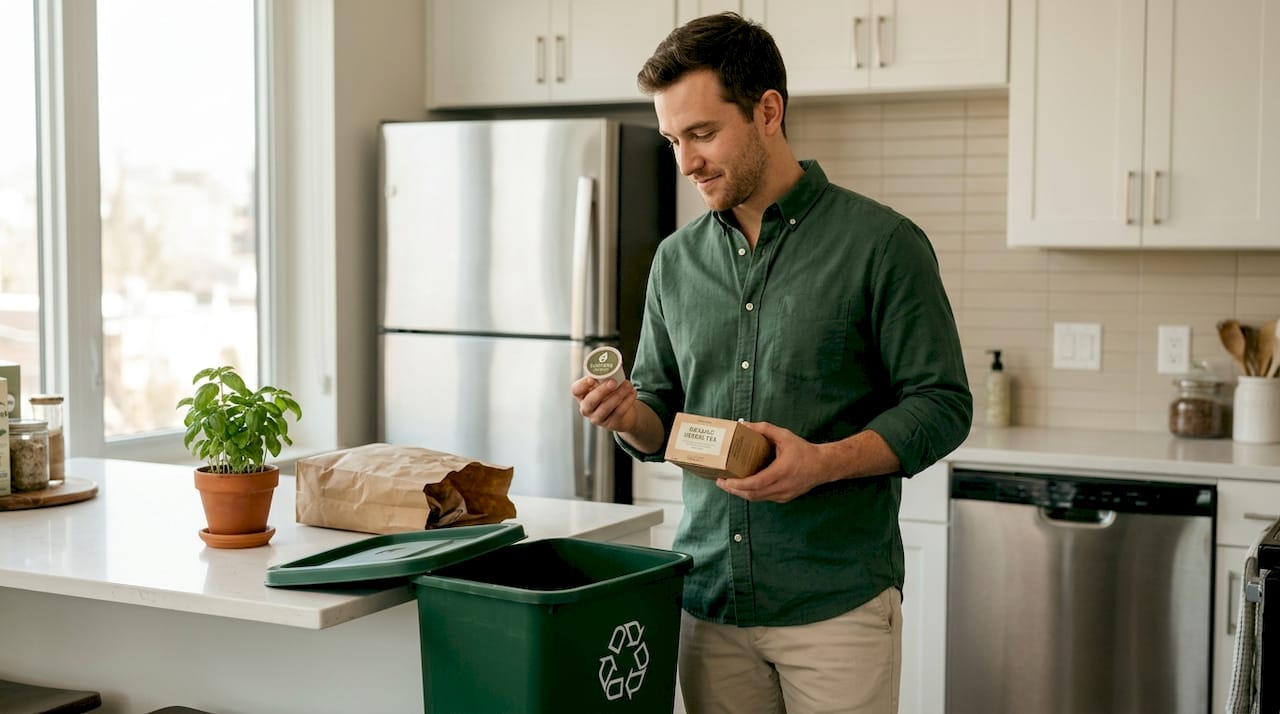
Here’s a number that might surprise you: packaging can account for a significant portion of a product’s total carbon footprint, sometimes comparable to the agricultural growing phase itself. Yet most shoppers focus almost entirely on what’s inside the bag and rarely on the bag itself. Choosing eco-conscious beverage packaging is one of the easiest high-impact upgrades you can make.
Single-serve coffee pods are a particular area worth paying close attention to. Conventional plastic pods are convenient, but they create enormous waste because most municipal recycling programs can’t accept them. The good news is that upcycled packaging benefits and compostable pod technology have advanced significantly, giving you genuinely good alternatives.
| Packaging Type | Recyclable | Compostable | Biodegradable | Carbon Impact |
|---|---|---|---|---|
| Standard plastic pod | Rarely | No | No | High |
| Compostable pod | No | Yes (industrial) | Partially | Lower |
| Recyclable pod | Yes | No | No | Medium |
| Loose-leaf/whole-bean bag | Sometimes | Sometimes | Varies | Lowest overall |
The EPA recommends prioritizing recyclable or upcycled packaging to minimize waste, and that guidance applies perfectly to your coffee and tea choices. There are also some inspiring examples of sustainable packaging in the broader beverage and food industry that show just how creative and effective low-waste packaging can be.
Here are the key packaging questions to ask before you purchase:
- What is the packaging made of? Look for recycled materials, plant-based materials, or certified compostable materials.
- How does the brand handle end-of-life? Does it offer a mail-back recycling program? Does it partner with composting facilities?
- Is packaging information published on the website? Brands committed to sustainability don’t hide their packaging specs.
- Does the bag or box carry any packaging-specific certification? Look for labels like “certified compostable” from the Biodegradable Products Institute (BPI), which is a recognized third-party standard.
Switching from conventional plastic pods to a compostable or recyclable alternative for your daily coffee habit can divert hundreds of pods from landfill every single year. Multiplied across thousands of like-minded coffee drinkers, that’s a genuinely meaningful shift.
Making your purchase count: Everyday habits for real impact
Packaging and certifications matter, but real transformation happens when intentional choices become a habit. Here’s how to make each cup count.
It’s easy to feel like individual actions are drops in the ocean. But empirical benchmarks show that certifications measurably benefit farmers and the climate, and that brand transparency and government action amplify that impact even further. Your choices do matter, especially when they’re consistent and informed.
Here are practical ways to build sustainable coffee and tea habits into your everyday routine:
- Subscribe to a certified brand rather than buying one-off. Subscription purchases provide brands with reliable revenue, which lets them plan long-term sustainability investments. It also keeps you from defaulting to a less sustainable option when you’re in a hurry.
- Talk about it. Share what you’ve learned with friends, family, and coworkers. Social influence is one of the most powerful drivers of consumer behavior change. When you recommend a certified brand in a group chat or bring it to the office, you multiply your impact.
- Ask your local grocery store or café to stock certified products. Retailers respond to customer demand. A simple request at the customer service desk or a note to a store manager can genuinely shift what ends up on shelves.
- Follow and engage with brands on social media. Brands that see engaged, values-aligned communities are more motivated to maintain and improve their sustainability standards. Your engagement is a form of accountability.
- Look for brands that support tangible initiatives like mangrove tree planting, ocean plastic removal, or clean water projects. These ways to support eco-conscious brands connect your purchase directly to measurable outcomes.
You can also take a broader approach to support green coffee initiatives by signing petitions, supporting policy changes that require supply chain transparency, and choosing to spend your money with brands that openly advocate for fairer trade rules.
Understanding the genuine benefits of responsible sourcing is also motivating. When you know that shade-grown coffee protects migratory bird habitats, that Fairtrade premiums fund rural schools, and that organic tea farming rebuilds mountain soil health, each morning cup feels less like a routine and more like a warm hug for both you and Mother Earth.
Pro Tip: Set a simple personal rule, such as “at least 80% of the coffee and tea I buy carries at least one major certification.” That kind of structured commitment removes decision fatigue and keeps your purchasing habits aligned with your values without requiring research every single time you shop.
The surprising truth about sustainable purchases
You now know how to make every purchase matter, but it’s equally important to have a clear-eyed view of what that impact can and cannot be.
Here at EcoVibe Roast, we believe in honest optimism. Certifications are genuinely valuable tools, and the research backs that up. But certifications alone cannot solve industry challenges. Real, lasting progress requires consumer advocacy, regulatory accountability, and brand-level commitments working together.
One thing that doesn’t get discussed enough is the barrier small producers face in obtaining certification. The auditing process costs money and time that many small family farms simply don’t have. This means some of the most genuinely sustainable farms on the planet aren’t certified, simply because certification access is unequal. When you can, support brands that go beyond the label and publish information about their direct relationships with farmers, especially smaller cooperatives.
It’s also worth knowing that certification effectiveness is limited by market dynamics and coverage gaps. Not every product category is equally well-served by existing schemes. Some tea-growing regions, for example, have far fewer certification options than major coffee-producing countries.
That’s why we encourage you to think of certifications in perspective as powerful starting points rather than complete solutions. They’re the foundation. What you build on top of that foundation through your choices, your voice, and the brands you champion, that’s what creates systemic change.
We’re not asking you to be perfect. We’re asking you to be intentional. An imperfect purchase from a transparently improving brand is often better than no purchase at all. Progress, not perfection, is the engine of real change.
Ready to make a difference with your next cup?
To put these practical tips into action, explore sustainable options that align with your values and simplify eco-friendly living.
At EcoVibe Roast, every purchase you make plants mangrove trees and removes ocean-bound plastics. You can start small with our eco-conscious 12 pack pods, featuring compostable single-serve options that don’t sacrifice rich, aromatic flavor.

Ready to commit to a bigger impact? Our sustainable 60 pack coffee pods make it easy to enjoy certified, responsibly sourced coffee every single day without adding to plastic waste. And if you want to see exactly where your contribution goes, our environmental impact page tracks the real-world results your purchases are generating, from coastal mangrove forests to cleaner oceans. Your next cup can be genuinely good for you and for the planet.
Frequently asked questions
What certifications should I look for when buying eco-friendly coffee or tea?
Look for Rainforest Alliance, Fairtrade, or Organic certifications, as these ensure environmental and social standards on farms and throughout the supply chain. Holding two or more certifications at once is an even stronger indicator of genuine sustainability commitment.
How do I know if a brand is truly sustainable or just greenwashing?
Check for third-party certifications, transparent supply chain disclosures, and published impact reports rather than just marketing language. The EPA recommends verifying impact through lifecycle reporting and documented certification details.
Does choosing certified coffee and tea really help the environment?
Yes, research shows it does. 122 studies confirm positive economic, social, and environmental effects from Fairtrade certification alone, though certification works best when combined with consumer advocacy and brand accountability.
Is sustainable packaging as important as the coffee or tea itself?
Absolutely, because packaging can significantly add to a product’s environmental footprint across its full lifecycle. The EPA recommends prioritizing recyclable or compostable packaging to minimize waste at every stage, from production through disposal.


