

TL;DR:
- Transparency in coffee supply chains involves detailed tracking of farm origin, fair pricing, and environmental impact data. It is crucial for combating deforestation, supporting smallholders, and enabling informed consumer choices. Achieving true transparency requires collaboration, technology, and long-term contracts that prioritize sustainability over superficial labels.
Every morning, millions of people pour a cup of coffee they believe is sustainably sourced. But the role of transparency in coffee supply reveals a less comfortable truth: many “sustainable” labels on grocery store shelves lack the traceability to back that claim up. From remote smallholder farms in Ethiopia to processing hubs in Vietnam, the path from coffee cherry to your mug passes through so many hands that real accountability gets lost. This guide breaks down what genuine transparency looks like, why it matters to farmers and forests alike, and exactly how you can use it to make every cup count.
Table of Contents
- Understanding transparency in coffee supply chains
- How transparency supports sustainable and deforestation-free coffee
- Challenges in achieving transparency for smallholder coffee farmers
- Transparency frameworks and certifications: comparing approaches
- How consumers can use transparency to make ethical coffee choices
- A unique perspective on transparency’s evolving role in coffee supply
- How EcoVibe Roast champions transparency in sustainable coffee and tea
- Frequently asked questions
Key Takeaways
| Point | Details |
|---|---|
| Transparency ensures trust | Transparency in coffee supply chains builds trust by verifying ethical and sustainable sourcing claims. |
| Technology aids monitoring | Satellite and AI mapping help detect deforestation risks and support regulatory compliance. |
| Smallholders face barriers | Many coffee farmers lack digital tools and land documents, requiring targeted support programs. |
| Certifications provide clarity | Certification schemes improve transparency by setting verified sustainability standards. |
| Consumers can drive change | Informed consumers empower transparency by choosing coffees with clear, credible sourcing information. |
Understanding transparency in coffee supply chains
So what does transparency actually mean when we are talking about coffee? It goes well beyond slapping a “responsibly sourced” badge on a bag. True coffee supply chain transparency means you can trace a specific lot of beans back to the farm, valley, or cooperative that grew them. It means the purchase price paid to the farmer is documented and fair. And it means the environmental impact of that farm, water use, shade cover, soil health, is measured and shared.
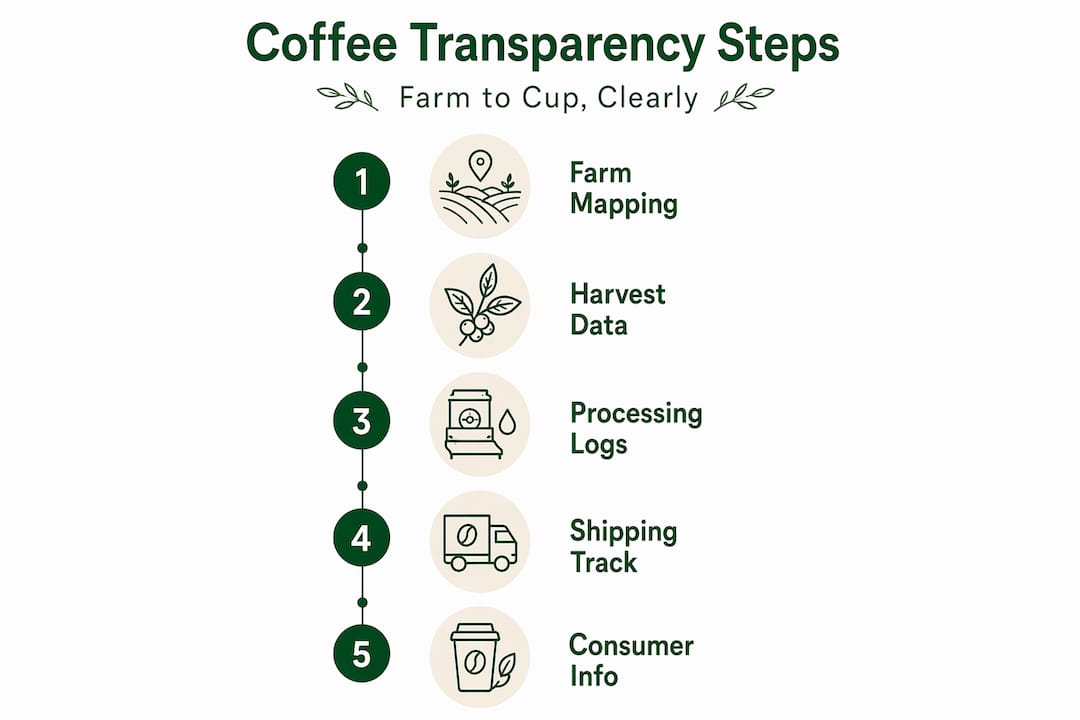
As transparency in coffee production demonstrates, it reveals when business relations are not as good as they seem, backing marketing claims with facts and enabling informed choices for everyone in the chain.
Here is what genuine transparency covers:
- Farm origin data: Specific region, farm, or cooperative name rather than a vague country label
- Pricing documentation: What the farmer was actually paid, not just the retail price you see
- Environmental metrics: Land use, biodiversity practices, and carbon footprint data
- Social indicators: Labor conditions, fair wages, and community investment records
The challenge? The global coffee trade runs largely through fragmented smallholder farms. Around 70% of the world’s coffee comes from small family plots, many of which have no formal records, GPS coordinates, or bank accounts. That fragmentation makes verification genuinely difficult, not just inconvenient.
Greenwashing is real in this space too. When you are reading labels, it pays to know how to spot greenwashing in coffee before trusting a “sustainable” claim at face value.
With a clear understanding of what transparency entails, we can now explore how it impacts environmental and social factors.
How transparency supports sustainable and deforestation-free coffee
Here is where transparency gets urgent. Coffee farming is one of the leading drivers of tropical deforestation, particularly in biodiversity-rich regions of Central America, West Africa, and Southeast Asia. Without accurate, field-level data, it is nearly impossible for roasters to guarantee their beans did not come from recently cleared forest land.
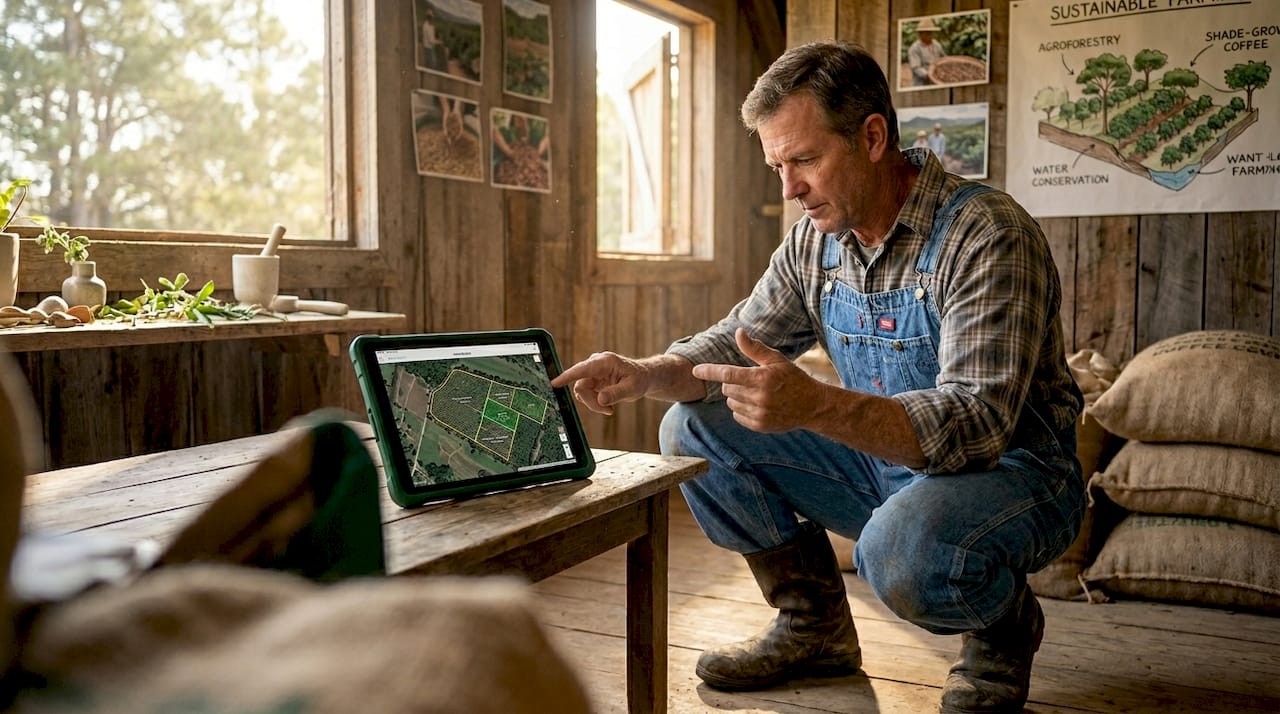
The good news is that technology is catching up fast. The Coffee Canopy Partnership, launched in 2026, uses satellite imagery and AI for global coffee farm mapping to ensure deforestation-free supply chains. This kind of precision was simply not available five years ago.
Regulatory pressure is also accelerating change. The EU Deforestation Regulation (EUDR) now requires companies selling coffee in Europe to prove that their supply chains are free from recently deforested land. That means GPS coordinates, land-use records, and third-party verification are no longer optional for brands wanting access to European markets.
Transparency genuinely matters here for a counterintuitive reason: it also protects smallholders who are already doing the right thing. Farmers practicing shade-grown, agroforestry-based coffee are at risk of wrongful exclusion if their land is incorrectly flagged by satellite systems. Accurate coffee deforestation documentation distinguishes the farmers who deserve support from operations that are causing harm.
Key environmental benefits of supply chain transparency include:
- Identifying and eliminating high-deforestation-risk sourcing zones
- Rewarding shade-grown and agroforestry farmers with premium pricing
- Providing verifiable data for carbon credit and biodiversity offset programs
- Supporting compliant farms in navigating the sustainability trends shaping 2026
Pro Tip: When a coffee brand shares a farm-level map or a specific deforestation audit report on their website, that is a strong signal they are investing in real transparency rather than surface-level messaging.
Now that we know how transparency underpins environmental protection, let’s examine the complexities smallholder farmers face in achieving compliance.
Challenges in achieving transparency for smallholder coffee farmers
Knowing transparency matters is one thing. Making it work for a farmer in rural Uganda or the highlands of Guatemala is quite another.
Here are the most pressing barriers smallholder farmers face:
- No formal land titles: Millions of farmers work land they have cultivated for generations but hold no legal deed. Without a title, formal geo-referencing and verification processes stall immediately.
- Limited digital access: Smartphones, GPS devices, and reliable internet are still out of reach for many farming communities, making data collection a burden rather than a benefit.
- Financial constraints: Participating in traceability programs often has upfront costs, including audits, app subscriptions, or cooperative fees, that small farmers simply cannot absorb alone.
- Language and literacy gaps: Many compliance documents and reporting platforms are designed for English-speaking, tech-literate users, which excludes a huge portion of the world’s coffee farmers.
As EUDR compliance research confirms, smallholders lack digital capacity and formal land documentation, slowing compliance despite progress in geo-referencing.
“Achieving true transparency in coffee supply requires treating smallholder farmers as partners, not just data points. Support programs, cooperative structures, and multi-year contracts are not charity. They are the infrastructure transparency depends on.”
The path forward is collaboration. Roasters, governments, NGOs, and tech companies each hold a piece of the puzzle. Programs that bundle training, hardware access, and legal documentation support are already proving effective in countries like Colombia and Kenya. You can learn more about how to support sustainable coffee farms and what that looks like in practice.
The most forward-looking brands are also funding these programs directly, recognizing that their ability to make transparency claims depends entirely on whether the farmers at the bottom of the chain have the tools to participate.
Having explored these challenges, let’s compare various transparency approaches and frameworks shaping the industry today.
Transparency frameworks and certifications: comparing approaches
Not all certifications are created equal, and understanding the difference can save you from buying into a label that sounds rigorous but delivers little.
| Framework | Focus area | Strength | Limitation |
|---|---|---|---|
| Fair Trade | Pricing and labor | Minimum price floors, farmer premiums | Limited traceability to farm level |
| Rainforest Alliance | Environmental and social | Audited standards, biodiversity focus | Audit depth varies by region |
| Direct trade | Relationship and pricing | Farm-specific, highest price transparency | No universal third-party standard |
| Regenerative ag. standards | Land health and carbon | Measurable outcomes, soil and water data | Still emerging, not widely adopted |
| Blockchain traceability | Full chain documentation | Near-real-time lot tracking | Expensive to implement at scale |
As transparency in coffee advocates, when marketing claims are backed by facts rather than assumptions, it enables more honest communication and challenges the commodity pricing model that keeps farmers trapped at the bottom.
A genuinely exciting development: Lavazza recently launched coffee certified under the Rainforest Alliance Regenerative Agriculture Standard, linking transparency with measurable sustainability outcomes at the field level. This approach goes beyond “do no harm” toward actively restoring ecosystems, a meaningful step forward.
Key things to look for when comparing certification claims:
- Does the certification audit include actual farm visits, or only document reviews?
- Are pricing details disclosed to the public, or kept within the supply chain only?
- Is there a mechanism for farmers to report issues anonymously?
Pro Tip: The most trustworthy brands layer certifications rather than relying on one. A bag of coffee carrying both a Rainforest Alliance certification and a direct trade relationship disclosure is giving you far more confidence than a single logo ever could. Browse resources on the impact of coffee certifications to sharpen your label-reading skills.
Understanding these frameworks allows consumers to identify truly transparent coffee products and make informed choices aligned with their values.
How consumers can use transparency to make ethical coffee choices
You have more power here than you might think. Every purchase is a vote, and knowing what signals to look for turns your morning ritual into a genuinely meaningful act.
Step-by-step guide to choosing transparent coffee:
- Read origin details closely. A bag that names a specific region, cooperative, or farmer is always more trustworthy than one listing only a country of origin.
- Look for disclosed purchase prices. Some transparent roasters publish exactly what they paid per pound above the commodity market price. That number tells you a lot.
- Check the roaster’s website for sourcing stories. Real transparency shows up in blog posts, sourcing reports, and farm profiles, not just a logo on packaging.
- Research their compliance commitments. Do they mention EUDR, deforestation audits, or geo-referencing? Brands engaging seriously with these topics are putting their supply chain under real scrutiny.
- Prefer collaborative traceability models. Companies that work with cooperatives and share data across the chain are building the kind of infrastructure that actually raises farmer incomes over time.
As transparent supply chains show, they enable actors along the supply chain to make informed choices and challenge commodity pricing that keeps farmers in cycles of poverty.
Here is a quick checklist you can use at a glance:
- Named farm or cooperative on the label
- Published pricing or price premium information
- Third-party certification with disclosed audit details
- Brand participation in deforestation-monitoring programs
- Active communication with the farming communities they source from
Supporting brands that practice responsible sourcing is one of the most direct ways to push the industry toward better standards. And if you want to go deeper, understanding the full sustainable sourcing workflow will give you a much sharper eye when evaluating new brands.
With practical tools in hand, let’s consider an expert perspective on the evolving role of transparency in coffee supply.
A unique perspective on transparency’s evolving role in coffee supply
Here is something most transparency conversations overlook: technology does not solve the problem if the economics remain broken.
Satellite imagery and AI mapping are genuinely impressive tools. But as experts studying EUDR readiness have noted, smallholders lack digital capacity, and the real fix requires third-party audits combined with multiyear contracts that include minimum price floors. The technology is only as good as the financial foundation beneath it.
Think about it this way. A farmer facing volatile commodity prices and no guaranteed buyer for next season has very little incentive to invest in data collection, sustainable practices, or land improvement. But offer that farmer a three-year contract with a guaranteed floor price, and suddenly the long-term thinking that real sustainability demands becomes possible.
This is why we think the most important transparency innovation is not a new app. It is a shift in contract culture. When roasters commit to supporting sustainable farms with multi-year financial agreements, they create the stability that allows farmers to participate meaningfully in traceability programs.
Industry-wide shared data platforms are also a game changer that deserves more attention. When multiple roasters pool geo-referencing costs and deforestation audit data, the burden on individual farmers drops dramatically. The coffee industry’s historic reluctance to share supply chain data as competitive advantage has actively slowed progress. That mindset is changing, but not fast enough.
The uncomfortable truth is that transparency is not a feature you add on top of the existing commodity system. It requires fundamentally rethinking how contracts, pricing, and relationships are built from farm to cup.
How EcoVibe Roast champions transparency in sustainable coffee and tea
What does all this look like in practice? At EcoVibe Roast, transparency is not a marketing checkbox. Every product on our shelves comes with clear origin information, ethical sourcing commitments, and a direct link to the environmental initiatives your purchase supports.

When you shop with us, you are not just buying an aromatic, rich cup of coffee or tea. You are contributing to something bigger. Our sourcing is tied to real environmental action: every purchase supports planting mangrove trees and removing ocean-bound plastics from coastlines. Explore our environmental impact page to see exactly where your dollars go.
Feeling adventurous? Try our Hibiscus Berry Tea, sourced with the same ethical rigor as our coffee line, or unwind with the delicate floral notes of our Jasmine Tea. Every sip is a small act of care for both the people who grew it and the planet we all share.
Frequently asked questions
Why is transparency important in the coffee supply chain?
Transparency ensures coffee is sourced sustainably and ethically, giving consumers verifiable facts rather than marketing promises. As coffee transparency research shows, it reveals when business relations are not as good as they seem and enables genuinely informed choices.
How are new technologies improving transparency in coffee sourcing?
Satellite imagery and AI provide accurate farm mapping and deforestation monitoring at a scale previously impossible. The Coffee Canopy Partnership’s 2026 launch is a leading example of how these tools are helping companies comply with EUDR and protect farmers who are already farming sustainably.
What challenges do smallholder coffee farmers face in achieving supply chain transparency?
Smallholders often lack both digital tools and formal land documents, which slows their ability to participate in compliance programs. Research on EUDR readiness confirms that geo-referencing progress is real but uneven, and targeted support programs remain essential.
How can consumers ensure their coffee purchases support transparency?
Look for named origins, published pricing premiums, and certifications with disclosed audit details on packaging. Brands committed to informed supply chain choices will make their sourcing data easy to find, not buried in fine print.
What role do certifications play in coffee supply transparency?
Certifications provide independently audited standards that verify sustainability claims beyond what a label alone can communicate. The recent Rainforest Alliance Regenerative certification represents a step beyond basic compliance toward measurable, positive environmental outcomes.
Recommended
- Sustainability Trends in Coffee 2026: Impact on Ethical Choices – EcoVibe Roast
- Sustainability trends 2026: Smarter, greener choices for coffee & tea – EcoVibe Roast
- Transparency in tea sourcing empowers eco-conscious buyers – EcoVibe Roast
- Spotting greenwashing in coffee: how to choose truly sustainable brews – EcoVibe Roast


